
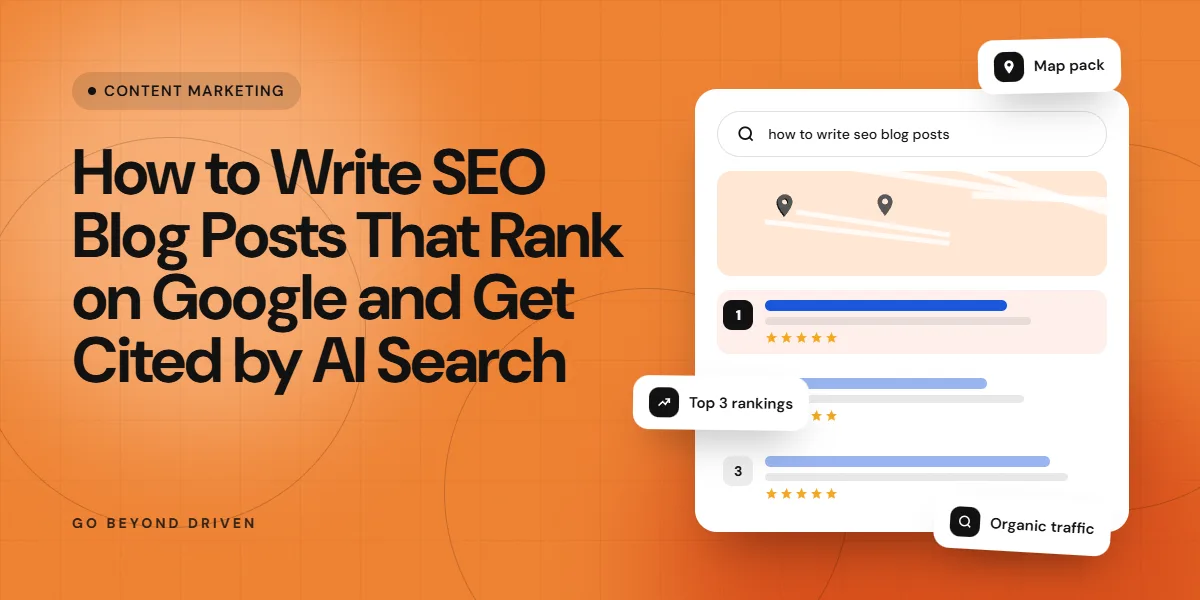
To write SEO blog posts that rank, pick one search query, understand what the searcher really wants, answer it clearly in the first lines, organise the rest under helpful headings and make the page easy for Google and readers to use. Keywords matter, but they are only the starting point. Today a post also has to prove real experience, load fast on mobile and give direct, quotable answers that AI search tools can cite. This guide takes you through the process in order: choosing a topic, checking intent, outlining, writing, optimising titles and links, adding FAQs and updating the post after it is live.
What makes a blog post SEO friendly?
An SEO friendly post matches a real search query, answers it better than the pages already ranking and is technically easy to crawl. That means a clear title, a descriptive URL, meaningful headings, original content, fast loading and internal links to related pages. It also means readers stay long enough to get what they came for.
Many beginners think SEO writing means repeating a keyword as often as possible. It does not. Google understands synonyms and context. What it rewards is a page that covers the topic completely, shows first-hand knowledge and satisfies the person searching. Write for that person first, then check the technical details.
How do you choose the right keyword for a blog post?
Start with what your customers type or ask. List the questions they raise before buying, then check each in Google. Look at autocomplete suggestions, People Also Ask and related searches. Choose a primary keyword that clearly matches one topic, and a handful of related phrases that fit naturally in headings and answers.
For a newer site, favour specific long-tail queries such as how to write seo blog posts for a clinic website rather than very broad terms such as blog writing. They have lower competition and clearer intent. Our guide to keyword research for small business shows how to build a practical list without expensive tools.
A good primary keyword is:
How do you check search intent before writing?
Search the keyword and study the top results. Are they step-by-step guides, lists, product pages, comparisons or definitions? The format Google shows tells you what searchers expect. If the first page shows how-to guides and you publish a sales page, you will struggle no matter how well you optimise.
Note what the best pages cover and what they miss. Perhaps they ignore costs in India, skip examples or give outdated advice. Those gaps are your chance to add value. Write down the main question, the likely follow-up questions and the stage of the reader. This becomes the backbone of your outline.

How should you structure a blog post for SEO?
Use one H1 title, then H2 headings for main sections and H3 headings where a section needs sub-points. Keep sections short and focused. Write headings as questions when people actually ask them, because a question heading followed by a direct answer is easy for Google and AI tools to extract.
A dependable structure is: a short introduction that answers the main query, a definition or quick answer, step-by-step sections or key factors, examples, mistakes to avoid, an FAQ and a closing section with the next step. Add bullet lists or a table where they help scanning. Our guide to topic clusters and pillar pages explains how individual posts fit into a bigger content map.
How do you write the opening so it answers the query fast?
Put the answer in the first two sentences. If the heading is how long should a blog post be, begin with a plain statement such as: long enough to answer the question completely, which is often between 1,000 and 2,000 words for a competitive topic, though a simple query may need less. Then expand with detail and nuance.
This answer-first style helps readers who are in a hurry and increases the chance that your text is quoted in featured snippets and AI summaries. Do not bury the answer under a long personal story or a history of the topic. Earn the reader's attention by being useful straight away, then reward them for staying with examples.
How do you write the body so it feels useful and trustworthy?
Add experience that competitors cannot copy: your own process, real project lessons, local examples, screenshots, numbers you actually track and mistakes you have seen. Use plain language, short paragraphs and concrete detail. Avoid padding, vague claims and statistics you cannot source. Where you reference a figure, name where it comes from, or leave it out.
Show who is writing. A short author line, relevant credentials or business background and a clear contact route help readers judge credibility. Review the text for accuracy before publishing, especially in areas such as health, finance and law. Our advice on website content writing tips covers tone and clarity in more detail.
FAQs: How do you write the body so it feels useful and trustworthy?
How long should a blog post be for SEO?
There is no fixed length. Cover the topic fully without padding. Many competitive guides run 1,200 to 2,000 words, while simple definitions may need far fewer.
Can I use the same keyword in every heading?
No. Use the main keyword in the title, introduction and a couple of headings, then use natural variations elsewhere so the post reads well.
What on-page SEO details should you finish before publishing?
Write a title that includes the keyword and promises a clear benefit, ideally under about 60 characters for the search result title. Write a meta description of roughly 120 to 158 characters that explains what the reader will get. Use a short URL containing the main words, and add descriptive alt text to every image.
Check that the page loads quickly on mobile, uses compressed images, has readable font sizes and contains no intrusive pop-ups. Add schema markup for articles and FAQs where appropriate. Our on-page SEO checklist lists each item, and a clean, readable address helps both people and crawlers understand the page.
Read the finished post once on a phone, since most Indian readers will see it there. Check that the table of contents, if any, is easy to tap, that lists do not overflow the screen and that the first screen shows the title and a direct answer. Fix anything that makes you pinch, zoom or scroll sideways before you hit publish. Small friction like this quietly raises bounce rates and wastes the ranking you worked to earn.
Final checks before you hit publish:
How should you use internal links and FAQs?
Link each new post to two to five related pages using descriptive anchor text, and update older posts to link back to it. Internal links help Google find content, understand topics and pass authority to important pages. They also help readers continue their journey. Our guide to internal linking strategy shows how to plan them.
Add an FAQ section with five to eight real questions drawn from People Also Ask, customer chats and your sales team. Write short, self-contained answers of around 40 to 80 words. Avoid repeating questions you have already answered in the body. Our FAQ content guide explains the format in more depth.
How do you keep a blog post performing after publishing?
Submit the URL to Google Search Console, share it through your channels and watch the first weeks for impressions, clicks and queries. Look at the real searches that bring people in and refine headings or add sections for the ones you missed. Improve the title if it earns impressions but few clicks.
Review important posts every six to twelve months. Update facts, prices, screenshots and links, remove sections that no longer help and merge overlapping pages. Our article on content pruning for SEO explains when to remove or combine weak content. A maintained library of a few strong posts will usually beat a large collection of neglected ones.
Final thoughts
Writing SEO blog posts is a craft of choosing the right question, answering it clearly and keeping the page useful over time. Follow a repeatable process and your content will serve readers and search engines alike. If you want help with strategy, writing or an audit of your existing posts, book a free marketing audit with Go Beyond Driven, call +91 91378 79539 or email gobeyonddriven@gmail.com.