
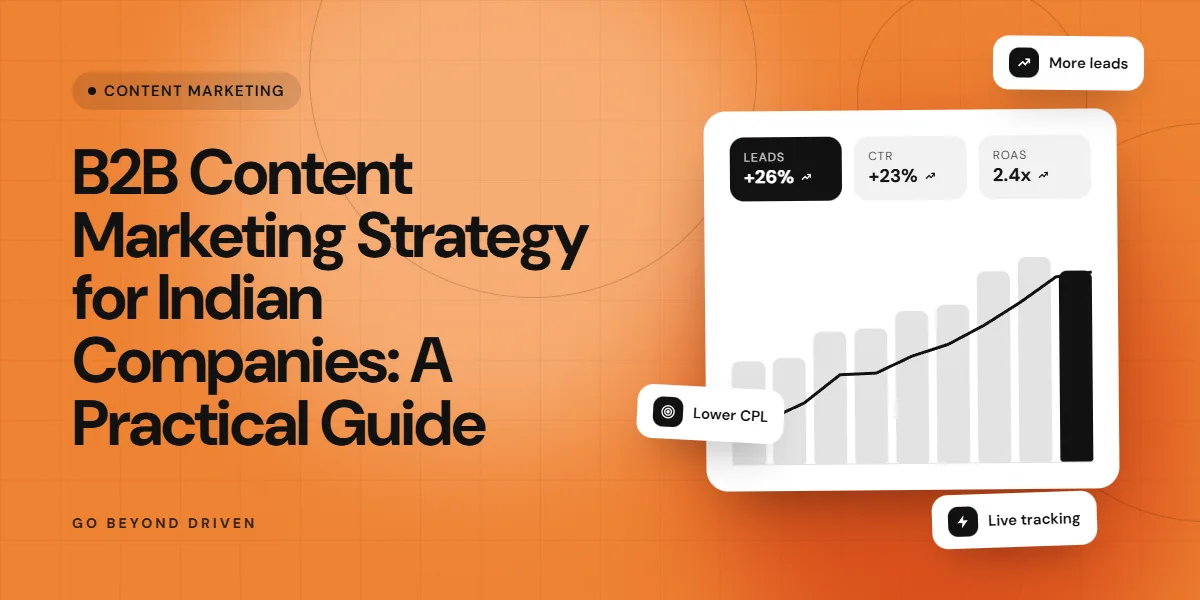
A B2B content marketing strategy is a plan for creating and distributing useful content that helps business buyers understand their problem, trust your expertise and choose you over competitors. For Indian companies, that usually means a focused mix of case studies, problem-solving guides, comparison pages, LinkedIn posts, webinars and email, all built around how your buying committee actually researches and decides. This guide gives you a step by step framework: setting goals, defining your ideal customer, mapping content to the buying journey, choosing formats, building SEO, distributing well and measuring pipeline impact. It is written for founders and marketing heads of manufacturers, SaaS firms, consultancies, logistics companies and professional services businesses who want enquiries, not just traffic.
What Is a B2B Content Marketing Strategy, and Why Does It Matter?
B2B buying is slow, high value and shared between several people. A plant head, a procurement manager, a finance controller and a managing director may all have a say in one purchase. Most of them research quietly before they ever speak to your sales team. They search on Google, read LinkedIn posts, ask peers on WhatsApp groups and look for proof that you have solved a similar problem before. Content is how you show up during that silent research phase.
A strategy turns random blogs and brochure posts into a system. It decides who you are writing for, what questions you will answer, which formats you will use, where you will distribute them and how you will measure results. Without one, Indian B2B companies often produce a burst of posts around a trade show, then go quiet for months. With one, every piece supports a pipeline goal, and your sales team has material to send at each stage of a deal.
How Do Indian B2B Buyers Research and Decide?
Indian B2B buyers rely heavily on trust and references. Referrals, existing vendor relationships and industry associations still carry a lot of weight. What has changed is that buyers now verify those references online. They check your website, look up your founders and team on LinkedIn, read case studies and sometimes watch a product video before taking a call. A strong recommendation can still be lost if your digital presence looks outdated or thin.
Buyers also forward content internally. A useful PDF, comparison table or short explainer video often travels through email and WhatsApp to people you never meet. Price sensitivity is real, so content that explains total cost of ownership, return on investment or risk reduction helps your champion justify the decision. For companies selling into corporate hubs like BKC, Lower Parel or Thane's business parks, decision makers expect polished, specific content that respects their time.
What B2B buyers look for before they call:
Step 1: Set Business Goals and Define Your Ideal Customer
Start with the business goal, not the content calendar. Do you need more qualified enquiries from a new industry, shorter sales cycles, larger deal sizes or better retention of existing accounts? Each goal leads to different content. A company trying to enter the pharma sector needs sector-specific case studies and compliance explainers. A firm trying to shorten sales cycles needs objection handling content, demos and pricing guides that answer questions before the first meeting.
Next, write an ideal customer profile. Define the industries, company size, geography and typical trigger events that make a company ready to buy, such as a new plant, a funding round or a regulatory change. Then list the roles involved in the decision and what each one cares about. The plant head worries about downtime, finance worries about cost and payback, and the managing director worries about risk and reputation. Your content needs to speak to each of them.
Step 2: Map Content to the Buying Journey
Map your content to three broad stages. At the awareness stage, buyers are trying to understand a problem, so they need educational guides, industry insights and short LinkedIn posts that name the pain clearly. At the consideration stage, they compare approaches and vendors, so they need comparison pages, webinars, solution explainers and detailed case studies. At the decision stage, they need proof and reassurance: pricing guides, implementation timelines, references, ROI calculators and answers to procurement questions.
The fastest way to fill this map is to talk to your sales team. Ask them for the 20 questions prospects ask most often, the objections that stall deals and the reasons you lose to competitors. Each of those becomes a content idea. Many Indian B2B companies discover that their best performing content is not a clever thought leadership piece, but a plain, honest page answering how much a solution costs or how long implementation takes.
FAQs: Step 2: Map Content to the Buying Journey
How many content pieces do we need to start?
Start with eight to twelve strong pieces: three or four case studies, a few problem guides, one comparison page and a pricing explainer. Depth and usefulness matter far more than volume in B2B.
Should B2B content be gated behind a form?
Gate only high value assets such as detailed reports, templates or calculators. Keep guides and case studies open, because ungated content gets read, shared and indexed by Google more easily.
Step 3: Choose Content Formats That Earn Trust
Case studies are the most valuable B2B content format for most Indian companies. Structure each one as client context, problem, approach, results and a short quote. If clients will not allow their name, anonymise them by industry and size, but keep the specifics. Problem-solving guides come next, followed by comparison and alternatives pages, explainer videos, webinars with a client or partner, and practical tools such as checklists, templates or cost calculators.
Choose formats your team can sustain. A manufacturer with technical founders may do well with short shop floor videos and detailed technical articles. A consultancy may lean on founder-led LinkedIn posts and a monthly webinar. A SaaS firm might focus on product walkthroughs and integration guides. Whatever you choose, repurpose every major piece: a webinar becomes a blog, five LinkedIn posts, a short video and an email. Our content marketing services are built around this kind of repurposing system.
Step 4: Build an SEO Foundation for B2B Search
B2B search volumes are usually small, but the intent is strong. A search like "industrial water treatment company for pharma plants" may only get a handful of searches a month, yet one enquiry could be worth lakhs. Start with your service and solution pages, making sure each one targets a clear keyword, explains the offer in detail and includes proof. Then build supporting articles around problems, comparisons and costs. Our guide to keyword research for small business shows how to find these terms.
Technical basics matter too. Your website should load quickly, work well on mobile, have clean page structure and link related articles to the right service pages. Many B2B sites in India still hide their best expertise inside PDF brochures that Google struggles to read. Move that knowledge into proper web pages. If you want help with this foundation, our SEO team in Mumbai works with B2B companies on exactly this kind of structure.
Step 5: Distribute on LinkedIn, Email and WhatsApp
Publishing is half the job. LinkedIn is the main distribution channel for most Indian B2B companies, and posts from founders and senior team members usually reach more people than company page updates. Share insights from each new piece of content as native posts, carousels or short videos rather than just dropping a link. Our article on LinkedIn marketing for B2B companies covers formats and posting rhythms in detail.
Email remains one of the most reliable B2B channels. A monthly newsletter with one useful idea, one case study and one invitation keeps you in front of prospects during long sales cycles. WhatsApp works well for sharing content with existing contacts and channel partners, as long as you send only to people who have opted in and keep messages relevant. For accounts you really want, consider targeted LinkedIn ads that promote case studies to specific companies and job titles.

Step 6: Turn Content Into Sales Enablement
Content should make your sales team's job easier. Create a simple shared library, organised by industry, stage and common objection, so a salesperson can quickly find the right case study or guide to send after a meeting. Train the team to follow up with something useful instead of a generic "just checking in" message. A relevant article sent the day after a call often moves a deal forward more than another phone reminder.
Give sales a few specific assets for the decision stage: a short company credentials deck, two or three industry case studies, an implementation timeline, a pricing logic explainer and answers to common procurement questions. Ask for feedback every quarter. Which pieces get sent most? Which ones prospects mention in meetings? Which questions still lack good answers? That feedback loop keeps your content aligned with real deals rather than what the marketing team assumes buyers want.
How Do You Measure B2B Content Marketing ROI?
Traffic alone is a poor measure for B2B. Track three layers. First, reach and engagement: organic sessions to key pages, LinkedIn impressions, time on page and newsletter open rates. Second, conversion: enquiries, demo requests, downloads and replies that can be traced to content. Third, business impact: pipeline value and closed revenue from deals where content played a role. Set up conversion tracking properly in Google Analytics 4, using our GA4 guide for small business as a starting point.
Because B2B journeys are long, add a simple "How did you hear about us?" field on forms and ask the question on every first sales call. Record it in your CRM. Over six to twelve months you will see which content assets and channels show up repeatedly in won deals. Most companies find that a small number of pieces drive most of the impact, which tells you exactly what to create more of and what to stop producing.
Common B2B Content Marketing Mistakes to Avoid
The biggest mistake is writing about yourself instead of the buyer's problem. Pages full of "we are a leading provider" language rarely persuade anyone. The second is publishing in bursts and then stopping, which kills momentum on both LinkedIn and Google. Third, many companies ignore their sales team, so the content answers questions nobody is asking. Fourth, case studies are often too vague, with no numbers, no context and no named problem. Finally, teams measure likes instead of enquiries and pipeline.
Before you publish any piece, run through this quick checklist. Does it answer a real question from a prospect or salesperson? Is it written for a specific role and stage? Does it include proof, such as an example, numbers or a client story? Is there a clear next step, such as a related case study or a call booking link? Is it optimised for one main search phrase? Will sales actually use it? If the answer to most of these is yes, publish.
Pre-publish B2B content checklist:
Final Thoughts
A good B2B content marketing strategy is not about publishing more. It is about publishing the right things for the people who sign off on deals, then putting that content in front of them consistently. Start with your sales team's questions, build a small library of case studies and guides, distribute through LinkedIn and email, and measure pipeline rather than likes. Within a few quarters, content becomes one of your most dependable sources of qualified enquiries.
If you would like an outside view of where your current content and website are losing B2B buyers, book a free marketing audit with our team. We will review your positioning, website, SEO and LinkedIn presence, and share a practical plan your team can start using immediately. We work with B2B companies across Mumbai and India, with meetings in person or online, whichever suits you better.