To track sales from social media, tag every link you share with UTM parameters so website sales show their source in analytics, give every WhatsApp and DM entry point a source code, ask in-store customers how they found you, and record all of it in one simple sales sheet that you review monthly. The hard part for Indian businesses is that many social sales never touch a website: people find you on Instagram, chat on WhatsApp, pay by UPI or walk into the shop. Analytics alone will undercount those. This guide shows how to track each sales path separately, how to keep organic and paid results apart, which numbers to report and how a hypothetical plant nursery in Thane puts it together.
Why is it so hard to track sales from social media?
Because the buying journey jumps between apps. Someone watches your reel on the train, screenshots it, forwards it to a family WhatsApp group, searches your name on Google a week later and buys on your website, or calls and pays by UPI. Each step loses the trail. Forwarded links and screenshots, often called dark social, carry no tracking at all.
Privacy changes add to this. Browser and phone privacy settings limit cookies and tracking, and platforms report conversions using their own attribution rules. So you will never get a perfect number. The goal is a reliable, consistent estimate that shows whether social media is bringing sales and which activities bring most. The practical answer is to track each sales path separately, website, chat and store, because each one needs a different method, and then add them up in one place.
How do you track website sales from Instagram and Facebook?
Tag every link and record purchases properly. Add UTM parameters to bio links, Story links, Facebook posts and creator links, for example utm_source=instagram, utm_medium=social and utm_campaign=diwali_sale. Make sure your website records purchases as events in Google Analytics 4, ideally with order value, so you can see revenue by source. Our UTM parameters guide has naming rules that keep this tidy.
If you run Meta ads, install the Meta pixel and, where possible, the Conversions API, so Meta can match purchases to ad viewers. Our Meta pixel setup guide walks through it. Remember that GA4 and Meta count differently, so their numbers will rarely match exactly.
How do you track sales that happen in DMs and on WhatsApp?
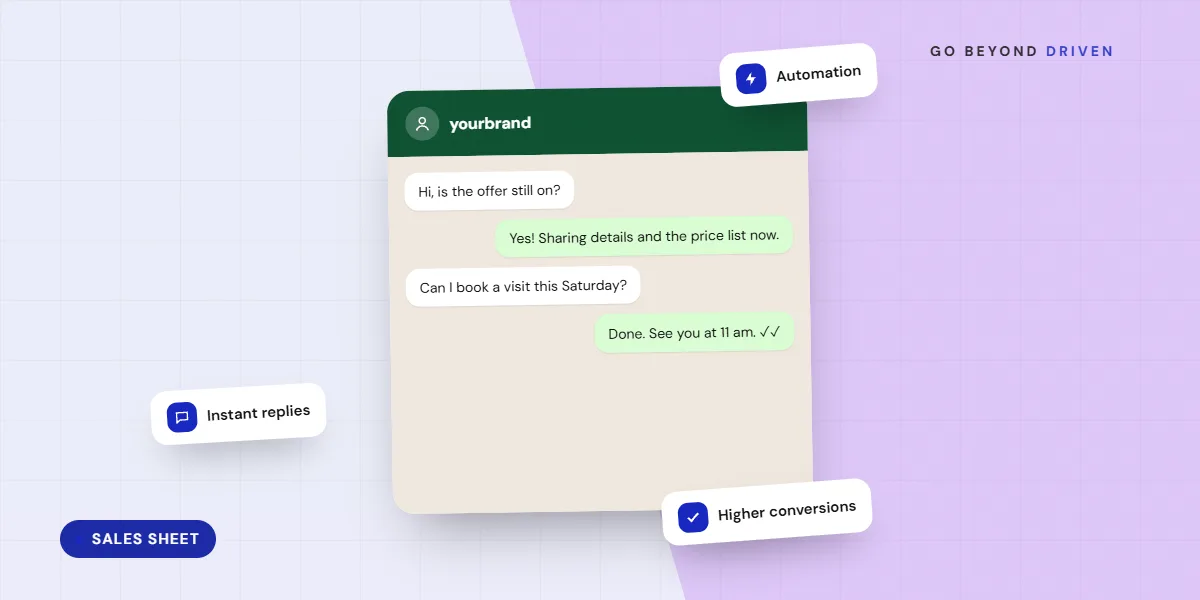
Give each entry point its own code and log every order with its source. Use prefilled WhatsApp messages such as 'Hi, I saw your reel (IG-REEL)' or 'Hi, from Facebook (FB-PAGE)', so the code arrives with the first message. In WhatsApp Business, label chats by stage, and when an order is paid, enter it in your sales sheet with the code.
For Instagram DM orders, note which post or Story the person mentioned, or ask simply: 'Which post brought you here?' Many buyers are happy to tell you. If you use a CRM or WhatsApp API tool, add a source field that is filled automatically from the code.
Simple source codes to start with:
How do you track in-store or offline sales from social media?
Use an offer, a code or a question. A social-only offer such as 'Show this Story at the counter for a free gift wrap' lets staff count redemptions. A code like INSTA10 entered at billing does the same in a POS system. And training staff to ask 'How did you hear about us?' and tick a box captures the rest.
For businesses where the sale closes later, such as interiors, real estate or education, record the source when the lead first arrives and carry it through to the final invoice. If you also advertise, our guide to offline conversion tracking shows how to send those offline sales back to Meta and Google, so the platforms learn which audiences actually buy rather than just enquire.
FAQs: How do you track in-store or offline sales from social media?
Do customers mind being asked where they heard about you?
Rarely, if the question is quick and friendly. Many enjoy saying they saw your reel. Keep it to one question with a few clear options.
Will discount codes cut my margin too much?
Use a small or non-cash benefit, such as free delivery or gift wrap. The aim is tracking, not a deep discount.
What should a sales from social media sheet include?
One row per sale, with the same columns every time. At minimum: date, customer name or order ID, sales path (website, WhatsApp, DM, store or call), source code or UTM campaign, product, order value, and whether it was a new or repeat customer. Add 'organic or paid' if you run ads. A shared Google Sheet is enough for most small businesses.
At month end, use a pivot table to sum sales and revenue by source and path. Even with gaps, this usually shows patterns quickly, such as Stories bringing more repeat buyers or reels bringing more first-time customers. Keep the sheet honest: if nobody knows where a sale came from, mark it 'unknown' rather than guessing. A rising unknown share tells you a tracking step is being skipped, usually at the counter or on WhatsApp during busy hours.
Columns for your sales sheet:
Worked example: a plant nursery in Thane
Say a plant nursery in Thane sells through its website, WhatsApp and a walk-in shop, and posts on Instagram five times a week. This is a hypothetical example. The owner adds UTM tags to bio and Story links, sets prefilled WhatsApp messages coded IG-BIO and IG-STORY, offers a free pot with the code GREEN at the counter and starts a sales sheet.
After one month, suppose the sheet shows 30 website orders from Instagram worth Rs 42,000, 55 WhatsApp orders coded from Instagram worth Rs 61,000, and 25 counter redemptions worth about Rs 20,000. GA4 alone would have shown only the first group. The owner now sees that WhatsApp is the biggest social sales path, so improves the WhatsApp greeting and catalogue first. The sheet also shows that monsoon plant-care reels brought more repeat buyers than new ones, which shapes next year's content calendar. All figures are illustrative.
How do you separate organic social sales from paid ads?
Use different UTM mediums and source codes. Tag organic links with utm_medium=social and ads with utm_medium=paid_social, and use separate WhatsApp codes for ads, such as AD-WA. In your sheet, mark each sale as organic or paid, based on the code or UTM it arrived with.
Treat Ads Manager figures with care. Meta attributes purchases within its own attribution windows, and some of those buyers may also appear as organic or direct in GA4. Do not add the two together. Use your own sheet as the main record and Ads Manager to compare ads with each other. Also expect some overlap you cannot untangle: a person may see an ad, ignore it, then buy after an organic Story a week later. Simple rules, applied consistently, matter more than perfect attribution.
Which social media sales numbers should you report each month?
Report a short, consistent set that a busy owner can read in two minutes: total sales and revenue attributed to social, split by path and by organic or paid; average order value; share of new versus repeat customers; and the top three posts, Stories or campaigns by sales. If you spend on ads, agencies or content, add cost per sale and return on that spend.
Compare month to month and season to season, since Diwali, wedding season or monsoon can change everything. Look for direction rather than precision. A sheet that is roughly right every month is far more useful than a perfect dashboard you build once and abandon.
When should you get help, and what does Go Beyond Driven do?
Get help when you spend real money or time on social media but cannot say what it brings, when analytics, Ads Manager and your sales do not agree, or before you scale ads. Setting up tracking properly once saves months of guessing, and it makes every later decision about content, creators or ad budgets easier to justify.
Go Beyond Driven sets up social sales tracking for Indian businesses: UTM schemes, GA4 purchase events, Meta pixel and Conversions API, WhatsApp source codes, simple sales sheets or CRM fields, and monthly reports in plain language. See our social media marketing agency page for how this fits with content and ads.
Final thoughts
Tracking sales from social media means accepting that no single tool sees everything, then building a simple system that catches each path: UTMs for the website, codes for WhatsApp and DMs, offers or questions in store, and one sheet that brings it together. Start this month and you will make better decisions by the next. For help setting it up, book a free marketing audit with Go Beyond Driven, or call or WhatsApp +91 91378 79539.