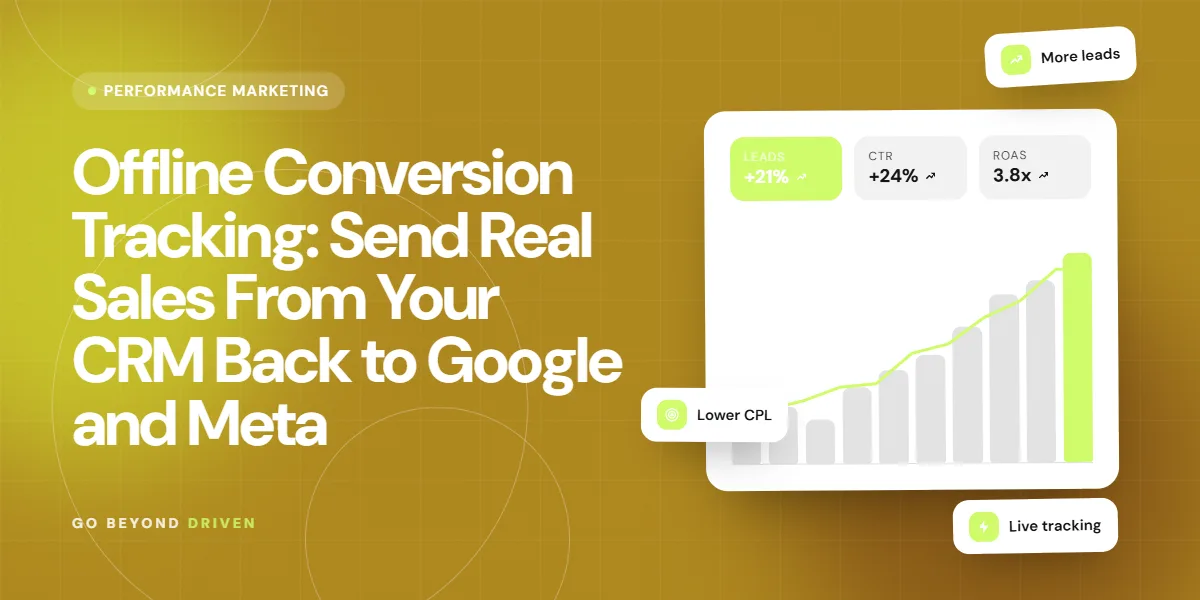
Offline conversion tracking is the process of sending results that happen outside your website, such as a qualified call, a site visit, a signed contract or a payment at your counter, back to ad platforms like Google Ads and Meta, matched to the ad click or lead that started it. Without it, the platforms only see form fills or clicks on a call button, so their algorithms learn to find people who fill forms, not people who buy. With it, bidding can favour the searches, audiences and ads that bring real customers. This guide explains which businesses need it most, how it works in Google Ads and Meta, what you need before you start, a worked example, how to handle calls and WhatsApp, and which events to send.
What is offline conversion tracking?
Offline conversion tracking connects what happens after a lead arrives with the ad that produced it. When someone clicks an ad and enquires, a click identifier or their contact details are saved with the lead. Later, when your team marks that lead as qualified, visited or sold in the CRM, the outcome is sent back to the ad platform with the identifier, so the platform knows which click led to the result.
The word offline is a little misleading. The sale might happen on the phone, over WhatsApp, at your showroom or through a payment link. What makes it offline is that your website tracking cannot see it. For lead based businesses, those unseen steps are where the money is made, so leaving them out of your ad data means optimising half blind.
Which businesses need offline conversion tracking most?
It matters most where the sale happens days or weeks after the enquiry, and where lead quality varies widely. Real estate, education and coaching, healthcare, B2B services, car dealers, interiors, insurance and financial services all fit. In these businesses, two campaigns with the same cost per lead can produce very different numbers of customers, and only offline data shows the difference.
It is less critical for an online store where the purchase happens on the website and is tracked directly, though even ecommerce brands with high cash on delivery refusals or phone orders benefit from sending corrected values. If your sales team regularly says that leads from one source are junk, offline tracking is how you prove it and teach the platforms to stop buying them.
Businesses that benefit most:
How does offline conversion tracking work in Google Ads?
Google Ads offers two main routes. The classic route captures the GCLID, a click ID added to your landing page URL by auto-tagging, in a hidden field on your form and stores it in the CRM with the lead. When the lead converts, you upload the GCLID, the conversion name, time and value, by file, by scheduled upload from Google Sheets, through the API or via a CRM integration. At the time of writing, uploads generally need to happen within 90 days of the click.
The newer route is enhanced conversions for leads, which matches uploaded results using hashed email addresses or phone numbers captured on the form, so it works even when a click ID is missing. Google has been steering advertisers towards this approach, so check the current recommendation in your account. Our guide to Google Ads enhanced conversions explains the setup.

How does offline conversion tracking work for Meta ads?
Meta handles offline and CRM events through its Conversions API. For instant form lead ads, each lead has a Meta lead ID. When the lead moves to a new stage in your CRM, you send an event with that ID, or with hashed email and phone, so Meta can match it to the person who saw the ad. For website leads, send stage events with the same match keys and, where available, the click ID Meta adds to landing URLs.
Meta has moved its older offline event uploads into the Conversions API, and its options for CRM integration change over time, so follow the current guidance in Events Manager. Many popular CRMs, including some used widely in India, connect through partner integrations or tools like Zapier. Our Meta Conversions API guide covers the basics.
What do you need before setting up offline conversion tracking?
You need a place where every lead lives with its outcome, usually a CRM, and a team that updates it. Forms should capture the click ID and contact details in hidden or visible fields, and pass them into the CRM along with the source. Define clear pipeline stages, such as new, qualified, visit or demo, and won, so everyone marks leads the same way.
You also need conversion actions created in Google Ads and events set up in Meta for each stage you plan to send, a consistent way to assign values, and a routine, daily or weekly, for sending data. Privacy matters too: tell people in your form notice that their details may be used to measure advertising, and only send hashed contact data that customers agreed to share.
Checklist before you start:
A worked example: an interiors studio in Thane
Say a hypothetical interiors studio in Thane spends around Rs 1 lakh a month on Google Search and Meta lead ads. Most leads come from people browsing ideas, and only a fraction book a site visit. Today both platforms optimise for form fills, so they find more browsers. The studio adds a hidden GCLID field to its website form, stores Meta lead IDs from instant forms and records every lead in a simple CRM.
It defines three offline events: qualified lead, meaning a confirmed budget and possession date; site visit done; and project signed, with an estimated value. Each week the coordinator uploads the qualified and site visit events. After several weeks of steady data, the studio switches Google bidding to optimise for qualified leads and site visits. Lead volume may fall, but if the share of leads that book a visit rises, cost per visit falls, which is the number that really matters.
How do you track phone calls and WhatsApp leads offline?
Calls and WhatsApp chats need their own identifiers, since there is no form to carry a click ID. For calls, use Google's call reporting with forwarding numbers on call assets and your website, or a call tracking tool that assigns numbers by source and can push call outcomes back to the platforms. Our guide to call tracking for ads covers the options.
For WhatsApp, record the source in the chat as early as possible. Pre-filled messages with a campaign code, a quick question about where the customer found you and tags in WhatsApp Business or your CRM all help. Meta's click to WhatsApp ads can report conversations and, through the Conversions API for business messaging, later outcomes. Phone numbers from chats can also be matched as hashed contact details.
FAQs: How do you track phone calls and WhatsApp leads offline?
Can I track sales from leads who call instead of filling the form?
Yes, partly. Call tracking numbers or Google forwarding numbers link calls to campaigns, and outcomes can be uploaded against the caller's number or call ID where the platform supports it.
What if my team forgets to update the CRM?
Then offline tracking will fail quietly. Keep stages few and simple, make updating part of daily follow-up and review lead status counts every week.
Which offline events should you send, and with what values?
Send the deepest stage that still happens often enough for the algorithm to learn from, plus the final sale for reporting. Platforms need a steady number of conversions to optimise well, so a stage that happens a handful of times a month is too rare to bid on. Many businesses bid on a qualified lead or appointment stage and report on won deals.
Give each stage a value that reflects what it is typically worth, using close rates and average deal size. If one in four site visits becomes a project worth about Rs 4 lakh in margin, a site visit is worth roughly Rs 1 lakh to you. Values let value based bidding favour the leads most likely to be profitable, which our guide on how to improve lead quality explores further.
When should you get help with offline tracking, and what does Go Beyond Driven do?
Bring in help when your ads produce plenty of leads but few customers, when sales and marketing argue about lead quality, or when you have a CRM but nothing flows back to Google and Meta. The setup spans forms, CRM fields, platform conversion actions and team habits, and small gaps such as a missing hidden field can break the whole chain.
Go Beyond Driven sets up click ID and contact capture on your forms, maps CRM stages to offline conversions, connects uploads to Google Ads and Meta's Conversions API, and moves bidding to qualified outcomes when the data is ready. Our lead generation company team then manages campaigns against cost per qualified lead and cost per customer.
Final thoughts
Offline conversion tracking is the difference between ads that find form fillers and ads that find buyers. Capture click IDs and contact details, keep your CRM stages clean, send the stages that matter with sensible values and give bidding time to learn. For a review of your setup, book a free marketing audit with Go Beyond Driven, or call or WhatsApp +91 91378 79539.