
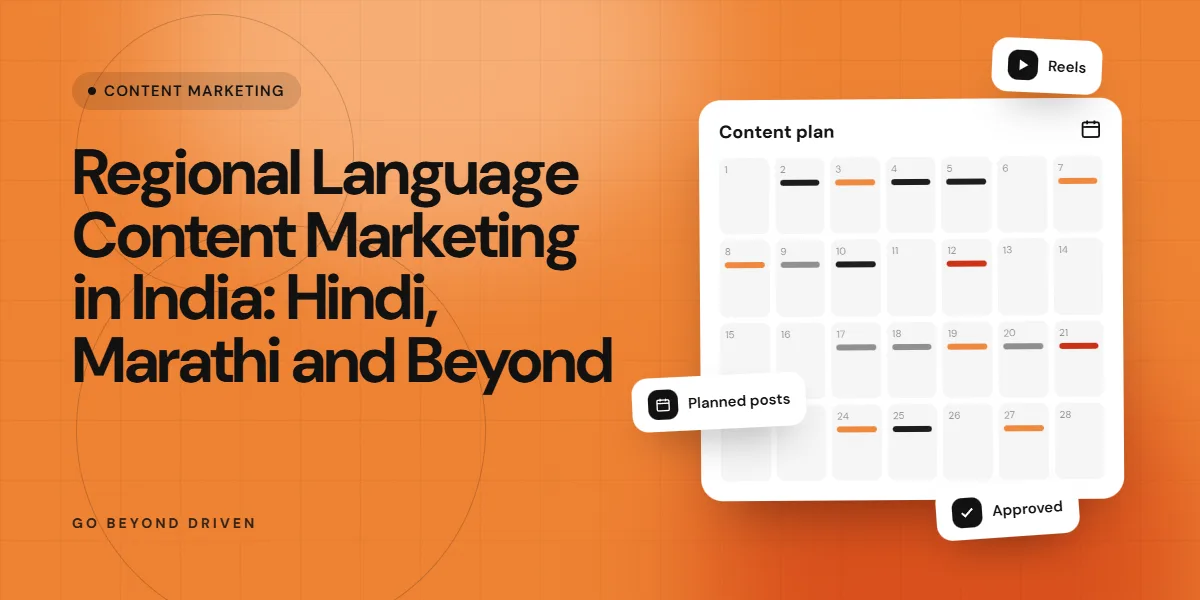
Regional language content marketing in India means creating websites, posts, videos and messages in languages such as Hindi, Marathi, Gujarati, Tamil, Bengali or Telugu, so that people can learn about and buy from you in the language they are most comfortable with. Many Indian buyers search, watch and chat in a mix of languages even when they work in English. A business that speaks to them in their own words often feels more trustworthy and easier to understand. This guide explains how to choose languages, write properly, handle SEO and distribute regional content without doubling your workload.
Why does regional language content matter in India?
India has many widely spoken languages, and a large share of internet users prefer to consume content in a language other than English. You do not need a statistic to see it. Look at the languages used in YouTube comments, WhatsApp forwards, local news and search suggestions in your own city. English may be the language of the dashboard and the invoice, but Hindi, Marathi or Gujarati is often the language of the decision.
For a Mumbai business, this matters sooner than most expect. A jeweller in Zaveri Bazaar, a clinic in Dombivli or a coaching class in Kalyan may serve customers who read English comfortably but trust information more when it comes in their mother tongue. Regional content lowers the effort to understand your offer, and lower effort often means more enquiries.
Which languages should your business start with?
Choose from evidence, not guesses. Check which languages your customers use in WhatsApp chats, call recordings, Google Business Profile questions and Instagram comments. Look at Search Console queries for Hindi or Hinglish terms. In Mumbai and the surrounding region, Marathi, Hindi and Gujarati are common starting points, while a business serving a specific community may need Tamil, Telugu, Malayalam or Bengali.
Start with one language in addition to English, and make it excellent before adding another. A half-translated website in four languages damages trust faster than a good one in two. Pick the language where you see both demand and revenue potential, and keep a list of the next language you will add when you have the team and the process to maintain it.
Signals that show which language to add:
Is translation enough for regional language content?
No. Direct translation often sounds stiff, misses cultural references and breaks sentence rhythm. Good regional content is written or adapted, not simply converted. A health tip for a Marathi audience should use the words local people use for symptoms, foods and festivals, not textbook vocabulary that sounds like a government form.
Use a native writer who understands your industry, then have another native speaker review it. If you use AI tools to draft, treat the output as a rough first pass and edit it with someone fluent. Pay particular attention to honorifics, tone, technical terms and numbers. Keep a glossary of approved terms, such as whether to say the English word or a Marathi equivalent for loan, EMI or appointment, so every piece stays consistent.
How does Hinglish fit into your content strategy?
Hinglish, the natural blend of Hindi and English written in either script, is how many urban Indians actually talk and type. It works well for social posts, short videos, captions, WhatsApp messages and conversational ads. A line such as a casual question in Hinglish can feel friendlier than formal English or formal Hindi, especially for younger buyers.
Use it where the tone suits the brand. A bank, a law firm or a hospital may need a more careful register for serious pages, while a cafe, a fashion label or a fitness studio can be playful. Also remember that people search in Hinglish, often using Roman letters for Hindi words. Including those natural phrases in headings and FAQs can help you appear for how people really type.
FAQs: How does Hinglish fit into your content strategy?
Should I write Hinglish in Roman or Devanagari script?
Use Roman script for casual social and chat content, since it is how many people type. Use Devanagari for formal Hindi pages and where readers expect it.
Can one brand use English and Hinglish together?
Yes, if the pattern is deliberate. Keep serious pages in clear English or Hindi and use Hinglish for social, ads and messaging.
How do you do SEO for regional language content?
Treat each language version as its own SEO project. Research keywords in the language itself, since search habits do not mirror English queries. Use native script and common spellings, write unique titles and meta descriptions, and give each language its own URL, such as a folder for Marathi pages. Mark relationships between versions with hreflang tags so Google can show the right page to the right user.
Check your fonts and page speed. Some Indian-language fonts are heavy, and a slow mobile page loses readers. Test on an average Android phone on a normal mobile connection, not only on office wifi. Voice search matters too, because many people speak queries in their own language. Our guide on voice search optimisation covers how to write answers that suit spoken questions.
What formats work best for regional audiences?
Video and audio often lead, because they remove the reading barrier and carry tone. Short reels, YouTube explainers, voice notes and podcasts in the local language can work well. Support them with captions, since many people watch without sound in public places or on the train. Clear visuals, simple infographics and short checklists also travel well on WhatsApp.
Written guides still matter for search and for serious purchases such as property, loans, health and education. Combine them: a Marathi article for search, a short video summary for social and a WhatsApp card for the list. Our content marketing agency team plans these combinations so one idea can serve several formats and several languages.
Formats to test in a regional language:
How can you distribute regional content on WhatsApp and social media?
WhatsApp is usually the strongest distribution channel for regional audiences, because it is where family, neighbours and trade groups already talk. Build an opted-in list segmented by language, then send short, useful messages in the language each person prefers. Include a clear next step, such as a call, a reply or a booking link. Our WhatsApp marketing services page explains how we set this up compliantly.
On Instagram and Facebook, use regional hashtags, local festival tie-ins and community pages. Collaborate with local creators who speak naturally in the language. Keep comments in the same language when you respond. A quick reply in Marathi or Gujarati to a customer question builds more goodwill than a polished English post ever could.
How do you measure regional language content?
Set up reporting by language from the start. Create separate views in Google Analytics for each language folder, track enquiries and calls from those pages, and tag WhatsApp links with language-specific parameters. Compare engagement, enquiry rate and sales quality, not only traffic. A smaller audience that converts well may be more valuable than a larger one that only browses.
Collect qualitative feedback as well. Ask your sales team which language customers use on first contact, and read comments for confusing words. Review each language every quarter: keep what works, rewrite what confuses and drop what no one reads. Regional content gets better through iteration, and the first version rarely lands perfectly.
What mistakes should you avoid in regional language marketing?
Avoid machine translation without review, mixing scripts inconsistently, using stock images that do not reflect local life, and launching in a language without anyone able to answer enquiries in it. A Marathi ad that leads to a call handled only in English damages trust right away. Make sure your phone team, chat team and follow-up messages match the language promised.
Also avoid assuming that one regional language fits a whole state or city. Marathi in Pune, Mumbai and rural Maharashtra differs in vocabulary and tone, and Gujarati in Mumbai can differ from Gujarati in Ahmedabad. Test with a small audience and listen carefully before scaling.
Final thoughts
Regional language content marketing in India is a long-term trust investment. Start with one language, write for real people rather than translating word for word, optimise each version for search, use WhatsApp and video, and measure each language separately. If you want help planning a multilingual content programme, book a free marketing audit with Go Beyond Driven, call +91 91378 79539 or email gobeyonddriven@gmail.com.