

Meta ads for real estate can fill a sales team's pipeline in days, but most developers and brokers in Mumbai know the frustration that follows: numbers that do not answer, people who never filled the form, and buyers whose budget is half the project price. The platform is not the problem. Lead quality depends on how you set up the form, what your creative promises, whom you target and, most of all, how quickly and consistently your team follows up. This guide covers the full system: choosing the right campaign type, writing qualifying questions, building creative that attracts serious buyers, connecting leads to a CRM and sending quality signals back to Meta so it finds more people who actually book site visits.
Why do real estate businesses use Meta for lead generation?
Property buyers spend a long time deciding, and much of that time is spent on Instagram and Facebook. They watch walkthrough Reels, follow developer pages and save posts about upcoming projects in Thane, Navi Mumbai or the western suburbs long before they search for a specific project name. Meta lets you reach these people with visual, location based ads at a cost per thousand impressions that is usually lower than Search, and with lead forms that open inside the app so a buyer can share interest in a few taps.
Meta is especially useful at launch and pre-launch stages, when there is little search demand for a new project name. It also helps resale brokers and rental agents build a steady flow of enquiries in a specific micro-market. For developers with several projects, Meta's catalogue and carousel formats can show different configurations and price points to different audiences. The challenge is not reach. It is converting that reach into conversations with buyers who are ready and able to purchase.
Which campaign type should you choose: instant forms, website or WhatsApp?
You have three main options. Instant forms keep the buyer inside Facebook or Instagram and usually deliver the lowest cost per lead, but also the most casual enquiries. Website conversion campaigns send people to a project landing page where they read details, see floor plans and then enquire, which typically costs more per lead but brings more informed buyers. Click-to-WhatsApp campaigns open a chat with your sales team, which suits Indian buyers who prefer messaging to forms.
Most developers do well with a mix. Use instant forms with the higher intent setting for volume, a website campaign for buyers who want to study the project, and WhatsApp for quick conversations and brochure sharing. Compare each by cost per site visit, not cost per lead. A Rs 300 lead that never answers is more expensive than a Rs 900 lead that visits the site. Our Click-to-WhatsApp ads guide explains how to set up the chat route properly.
FAQs: Which campaign type should you choose: instant forms, website or WhatsApp?
What is a higher intent lead form?
It adds a review screen where the person confirms their details before submitting. It reduces accidental and low effort submissions, so volume drops a little but quality usually improves.
Should I send leads to a landing page or use instant forms?
Test both. Instant forms give volume at a lower cost, while landing pages filter for buyers who read details. Judge them by site visits and bookings.
How do you write lead form questions that filter out junk?
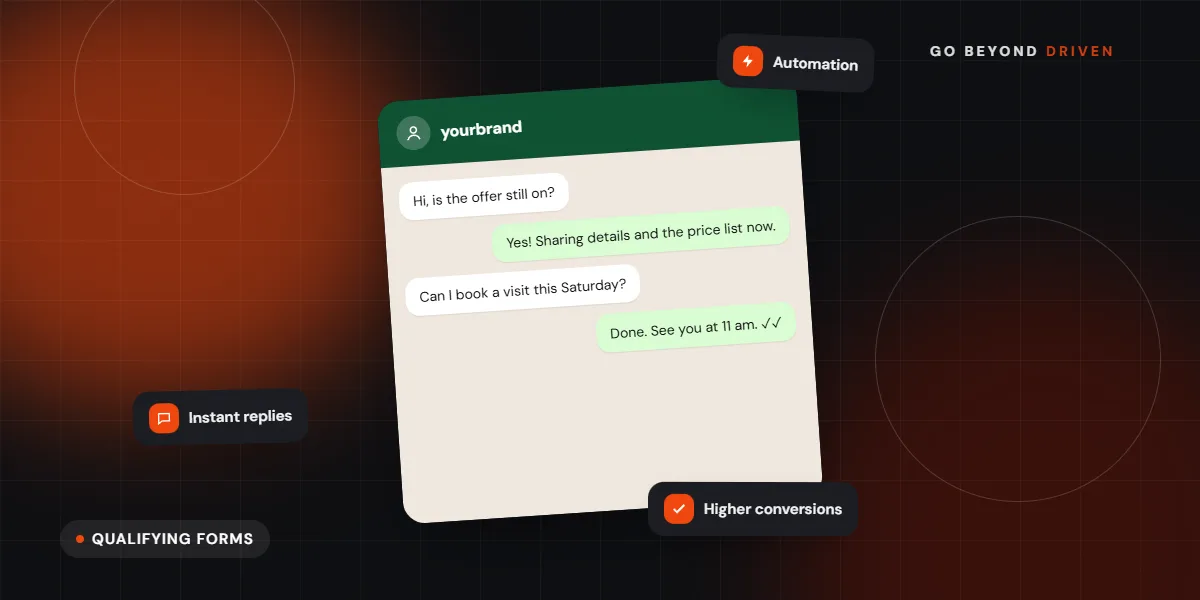
The default form asks only for name, phone and email, which Meta autofills. That makes submitting effortless, so you get curious scrollers along with serious buyers. Add two or three short qualifying questions that a casual person would not bother to answer. Good ones for property include preferred configuration, such as 1, 2 or 3 BHK, budget range, purchase timeline, whether the buyer is looking for self use or investment, and whether they want a site visit this week or next.
Use multiple choice answers rather than open text, so the form stays quick on mobile and your team can sort leads easily. Put the price clearly in the ad or on the form intro screen, such as 'starting from' a figure, so buyers outside your range self select out. Add a context card that lists the location, possession date and key amenities. A few extra seconds of friction in the form often saves your sales team hours of calls to people who were never going to buy.
Useful qualifying questions:
What creative works for property ads on Instagram and Facebook?
Buyers want to picture themselves living there. Short walkthrough videos of the sample flat, views from the balcony, drone shots of the location and clips of amenities usually beat static renders with long text. Lead with the most important facts in the first three seconds: the location, the configuration and the starting price. Then show proof such as connectivity to stations and highways, nearby schools and hospitals, and the developer's track record of delivered projects.
Test a few creative angles rather than one. A price and payment plan angle, a lifestyle and amenities angle, a location and connectivity angle, and a trust angle featuring delivered projects or customer testimonials will often perform very differently. Keep claims accurate and approved, and include your RERA details. In Maharashtra, MahaRERA requires the project registration number, and in recent rules a QR code, on project advertisements, so confirm the current requirements with your compliance team before launch. For organic content ideas that support your ads, see our guide to Instagram marketing for real estate developers.
How should you target property buyers on Meta?
Start with location. Target a sensible radius around the project and the areas buyers usually move from. A project in Thane might draw from Mulund, Ghatkopar and parts of the central suburbs, while a premium project in Worli might draw from across South and Central Mumbai and from NRIs in key markets. Keep age ranges realistic for your product, and let Meta's Advantage+ audience expand from your suggestions once you have conversion data, rather than stacking dozens of narrow interests.
Housing ads may need to be declared under Meta's special ad category depending on the market and current policy, which can limit some targeting options, so check the rules in Ads Manager before launch. Build custom audiences from website visitors, video viewers and people who opened but did not submit your form, and use them for retargeting. Exclude existing customers and leads already in your CRM so you do not pay to reach the same people again.
Why does speed of follow-up matter so much?
A Meta lead is warm for a very short time. The buyer filled the form between Reels, and within an hour they may have forgotten your project or enquired with two others. Calling within the first few minutes, while the ad is still fresh in their mind, makes a large difference to how many leads you can reach and qualify. Leads that sit in a spreadsheet until the next morning are the main reason developers believe Meta leads are fake.
Set up instant lead delivery to your CRM or at least to the sales team's phones through an integration. Send an automatic WhatsApp message with the brochure, location pin and a site visit booking link within seconds of the form submission. Then call. If the buyer does not answer, follow a fixed sequence of calls and messages across the next few days. Our WhatsApp marketing services can automate this first touch without losing the personal feel.
FAQs: Why does speed of follow-up matter so much?
How fast should we call a Meta lead?
Aim for the first few minutes during working hours. The sooner you call, the more likely the buyer remembers the ad and answers the phone.
What if leads come in at night?
Send an automatic WhatsApp reply with the brochure and a booking link, then call first thing the next morning. Consider scheduling ads around your sales team's hours.
How do you connect Meta leads to a CRM and feed quality back?
Every lead should land in a CRM with its campaign, ad set and ad recorded. That lets you see which ads produce site visits and bookings, not just form fills. Define clear stages such as new, contacted, qualified, site visit scheduled, site visit done, negotiation and booked. Train the sales team to update stages the same day, because the data is only as good as the discipline behind it.
Then send those stages back to Meta using the Conversions API for CRM, and switch the campaign optimisation to conversion leads once you have enough volume. Meta will start to learn which people turn into qualified leads and site visits, and find more like them rather than more cheap form fillers. This is often the single biggest step change in lead quality, and it works best when your CRM stages are honest and updated consistently.

What does a good real estate lead funnel look like?
A strong funnel has layers. At the top, video and carousel ads build awareness among likely buyers in your target areas. In the middle, lead forms, landing pages and WhatsApp chats capture interest. At the bottom, retargeting ads show testimonials, payment plans and site visit offers to people who engaged but did not enquire, or who enquired but did not visit. Each layer has its own creative and its own measure of success.
Your website matters even when most leads come through forms. Buyers check the developer's site, project pages and Google reviews before they visit. A fast project page with floor plans, location map, amenities, RERA details and a clear enquiry option builds trust that improves your close rate. Our guide on real estate website design features covers what to include, and our performance marketing team in Thane works with projects across the MMR.
Which numbers should you track each week?
Track the full chain, not just the top. Each week, record spend, leads, contacted leads, qualified leads, site visits scheduled, site visits completed and bookings, split by campaign and creative. From those, calculate contact rate, qualification rate, cost per qualified lead, cost per site visit and cost per booking. These ratios tell you where the funnel leaks. A low contact rate points to slow follow-up or junk forms. A low visit rate points to weak pitching, the wrong price band or a project page that does not build enough trust.
Share this sheet with both the marketing and sales teams and review it together. When sales sees which ads produce visits, they give better feedback, and when marketing sees which leads close, they stop chasing volume. Over a few months this shared view usually does more for cost per booking than any single targeting or creative change.
Mistakes to avoid with real estate lead ads
The most expensive mistake is optimising for the cheapest lead. Cheap leads are easy to buy and hard to close. Other common errors include hiding the price, which attracts buyers who cannot afford the project, using the same render in every ad for months until it fatigues, targeting all of Mumbai for a project with a clear local catchment, and running ads at full spend on weekends when the sales team is off.
On the follow-up side, the usual mistakes are calling hours or days late, making only one attempt, not using WhatsApp, and not recording outcomes in a CRM. Without outcome data, nobody can say which ads work, and Meta cannot learn either. Finally, avoid judging a campaign on its first few days. Allow the learning phase to complete and review on cost per site visit across at least a few weeks.
Real estate lead ad checklist:
Final thoughts
Meta ads for real estate work when they are treated as a system rather than a lead tap. Clear pricing, honest qualifying questions, strong video creative, fast follow-up and CRM feedback together turn cheap enquiries into site visits and bookings. If your property campaigns are bringing volume without results, our performance marketing agency can review the full funnel. Book a free marketing audit with Go Beyond Driven, call +91 91378 79539 or email gobeyonddriven@gmail.com.