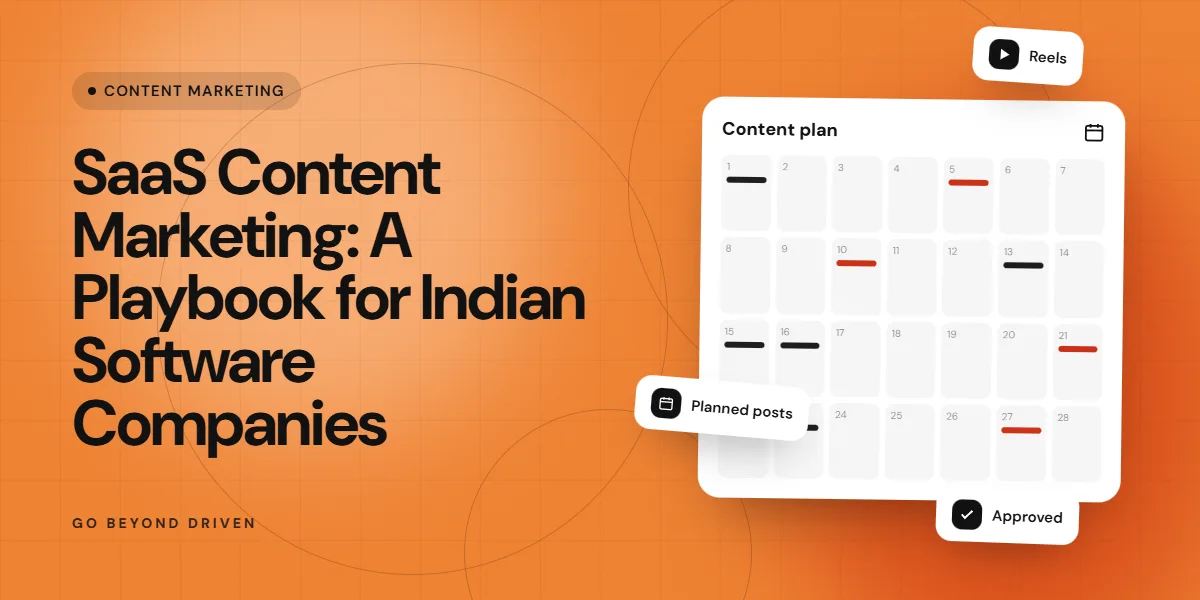
SaaS content marketing is the use of articles, guides, comparison pages, templates and tools to attract people who have the problem your software solves and move them towards a trial or demo. Unlike a consumer blog, SaaS content has to earn its place in a long, committee-driven buying process, often involving a user, a manager and someone who signs the cheque. That means topic choice matters more than volume: a hundred generic posts will lose to ten pages that sit close to real buying questions. This guide covers how Indian SaaS teams can choose topics, build a funnel of content, link it to the product and measure it against pipeline.
How is SaaS content marketing different?
SaaS content has a direct job to do: connect a pain to your product. A reader searching for how to reconcile vendor invoices is a possible customer of an accounts payable tool, while a reader looking for general business tips is not. Good SaaS content therefore starts from the problem your product removes and works outwards, rather than starting from whatever keywords have high volume.
The sale is also longer and involves more people. Content must serve the day to day user who feels the pain, the manager who owns the outcome and the finance or IT stakeholder who worries about cost, security and integration. Mapping a page to one of those readers makes it sharper and easier to measure.
How do you choose topics for SaaS content?
Rank topics by how close they are to a purchase. Bottom of funnel topics include comparisons, alternatives, pricing, integrations and use cases. Middle topics include how-to guides, templates and frameworks for the job your software supports. Top topics include broad education for the wider category. Most early-stage teams should spend the majority of effort on the first two, because they convert sooner.
Mine real sources for ideas: sales call recordings, support tickets, onboarding questions and lost deal notes. Check search demand with a keyword tool, but do not skip a topic because the volume looks small. A page that gets fifty relevant visits a month from people comparing vendors can be worth more than a post with ten thousand casual readers.
Topics close to purchase:
What does a SaaS content funnel look like?
Think of three layers. The first layer is search-led educational content that matches the problem. The second is evaluation content such as case studies, comparison pages, product walkthroughs and ROI calculators. The third is conversion content, including the demo page, free trial page, pricing and onboarding emails. Each layer should link naturally to the next.
Make the path visible. An educational guide should point to a relevant template, which links to a feature page, which offers a trial or demo. Avoid pushing a demo button in the first paragraph of a beginner guide, but do give readers a sensible next step. For a wider view of B2B planning, see our B2B content marketing strategy guide.
Do not forget the post-signup layer. Onboarding emails, in-app tips and help centre articles are content too, and they decide whether a trial becomes a paying customer. Write them with the same care as your blog, because a confused new user rarely stays long enough to see the value.
Which content assets do SaaS companies need first?
Start with the pages a buyer will look for when they are close to deciding: a clear product page for each main use case, a pricing page that explains plans, an integrations page, a security and data privacy page and two or three honest comparison pages. Indian buyers often want to know about GST invoicing, data hosting location, support hours in IST and WhatsApp or phone support, so answer those plainly.
Next, add a few customer stories with permission, a free template or calculator related to your category, and a handful of how-to guides. Resist the urge to publish a calendar of thin posts. A small, strong library of assets, kept current, outperforms a large one that nobody updates.
FAQs: Which content assets do SaaS companies need first?
Are comparison pages risky?
They can be if they are inaccurate or unfair. Compare on facts you can verify, date the page, avoid disparaging language and update it when features or prices change.
Should SaaS content be gated?
Gate only assets with clear value, such as templates or research, and keep educational guides open so they can rank and be shared. Test forms with short fields, since long forms reduce downloads.
How does SEO fit into SaaS content marketing?
Search is a major channel for SaaS because buyers research problems on Google before they contact anyone. Build topic clusters around your core use cases: one strong pillar page, supported by detailed articles that link to it and to the product pages. Match each page to one search intent and make sure the page genuinely answers it better than the current top results.
Technical basics still matter: fast pages, clean URLs, schema where suitable, and internal links that distribute authority to money pages. Our guide to topic clusters and pillar pages explains the structure, and our SEO company in Mumbai page shows how we support software and service brands. Keep a changelog of what you updated and why.
How do you make SaaS content product-led?
Product-led content shows the reader how to do the job, with your product as the practical way to do it. Instead of writing about invoice automation in the abstract, show a step by step workflow with screenshots, templates and the settings to use. Readers learn something real, and the product appears as a natural helper rather than a sales pitch.
Use the product itself as a content source. Release notes, feature walkthroughs, short video demos and public templates make useful pages. Ask your product team for the five most common setup mistakes and write about them. These pages tend to attract existing users and prospects at the same time, which helps retention as well as acquisition.

How do you promote SaaS content beyond Google?
Distribution deserves as much planning as writing. Turn strong articles into LinkedIn carousels, short founder videos, email newsletter items and replies in relevant communities where self-promotion is allowed. Share useful pages with your sales team so they can send them in follow-up emails after calls.
Email nurtures people who sign up but do not buy. A short onboarding series that links to the most useful guides can lift activation. Retargeting visitors to comparison and pricing pages with a case study or demo offer also works for many B2B firms. Our guide on content distribution strategy covers the channels in more detail.
Metrics worth reviewing monthly:
Which metrics matter for SaaS content marketing?
Traffic is a starting point, not a result. Track signups, trial starts, demo requests, qualified leads and pipeline sourced or influenced by content. Use first and last touch views in your analytics and CRM, and add a how did you hear about us field to forms so people can tell you what they read.
Review content by funnel stage. For bottom of funnel pages, watch conversion rate. For educational pages, watch engagement, signups to email and assisted conversions. Prune or merge pages that attract no relevant traffic after six to nine months, and refresh the best ones. Our content marketing metrics post lists what to monitor.
When should a SaaS company hire a content agency?
Outside help makes sense when the founders write well but have no time, when the team publishes inconsistently, or when traffic exists but demos do not follow. A good partner brings strategy, subject interviews with your product team, SEO research, editing, design and reporting against pipeline. It should not simply sell a fixed number of articles.
Go Beyond Driven supports software and service companies from Mumbai with content strategy, SEO writing and distribution. Learn more on our B2B digital marketing agency page, and expect plain reporting on what the content is doing for trials and demos.
Final thoughts
SaaS content marketing works when each page has a job: attract a person with a problem, help them decide and make the next step obvious. Start with bottom of funnel pages, add helpful guides around your core use cases and measure by pipeline. If you want an outside look at your content and search visibility, book a free marketing audit with Go Beyond Driven, call +91 91378 79539 or email gobeyonddriven@gmail.com.