The logo design process is a sequence of decisions that turns a business idea into a mark people can recognise and remember. It usually runs through briefing, research, sketching, concept development, presentation, feedback, refinement and delivery of final files. A professional process takes more than picking a font and an icon, because the logo has to work on a signboard, a WhatsApp profile picture, an invoice and a tiny favicon. This guide explains each stage, what you should provide, what a designer should deliver, how long it typically takes and how to give feedback that improves the result rather than sending it in circles.
What are the steps in the logo design process?
Most professional logo projects follow eight steps: discovery and briefing, research, ideation and sketching, concept design, presentation, feedback and revision, finalisation and delivery. Smaller projects may compress them, and larger brand projects add strategy, naming and brand guidelines. The order matters because decisions made early, such as who the audience is and what the brand stands for, shape every visual choice later.
Skipping steps usually shows in the result. A logo drawn before research may look attractive but resemble a competitor's, and a logo presented without context can be judged purely on personal taste. A clear process gives both client and designer a shared way to evaluate work, so feedback focuses on whether the idea suits the business rather than whether someone likes a particular colour.
The eight stages at a glance:
What goes into a good logo design brief?
A brief tells the designer what the business does, who it serves, what makes it different and where the logo will appear. Include your business name and tagline, your target customers, three to five competitors or brands you admire, the personality you want to project, colours or styles to avoid and any legal or cultural considerations. Mention practical uses, such as shopfront boards, packaging, uniforms or an app icon.
Be specific about the business, not the picture. Saying we want something premium but approachable is more useful than saying we want a lion. A good designer will ask follow-up questions, so set aside time for a proper conversation. If you are still shaping your positioning, our guide on brand positioning for startups helps you answer those questions first.
Why does research come before sketching?
Research stops the logo from being generic or accidentally similar to others. The designer studies your market, competitors, audience and visual conventions in your category. They look at how rival logos use colour, shape and typography, then look for space where your brand can be distinct. For a Mumbai restaurant or clinic, that might mean checking what neighbouring businesses already look like.
Research also covers practical constraints: where the logo will be printed, how small it must be, whether it needs to work in one colour and whether a name written in a regional script has to sit beside the English version. Conducting a quick trademark search before you commit is wise, so ask a legal professional about registration in India.
How do logo concepts get developed?
Designers usually start on paper or a tablet, producing dozens of rough thumbnails exploring different ideas: lettering, symbols, monograms or combinations. Weak ideas are filtered out quickly. The strongest few are then built digitally as vector artwork, tested in black and white first so the shape stands on its own before colour is added.
Typography, spacing, colour and proportion are refined at this stage. The designer considers how the mark looks large on a hoarding and tiny as a social media profile picture. Good concepts have a reason behind them: a story linked to the name, the founder, the product or the place. That reasoning is what you should be asked to judge, along with legibility and distinctiveness.
FAQs: How do logo concepts get developed?
How many logo concepts should I expect?
Practices vary. Many designers present between two and four considered concepts rather than dozens, because quality and reasoning matter more than quantity. Confirm the number in the proposal.
Should the logo work in black and white?
Yes. A strong logo holds up in one colour, on dark and light backgrounds and at small sizes. Colour should strengthen the design, not rescue it.
How should you give feedback on a logo?
Good feedback talks about goals, not tweaks. Say that the mark feels too corporate for a children's brand, or that the lettering is hard to read at small sizes, instead of asking for the icon to be moved two millimetres left. Let the designer solve the problem, because they understand how changes affect the whole system.
Collect opinions from a small group of decision makers and consolidate them into one set of comments. Too many voices lead to compromise designs that please nobody. Test the logo in real contexts, such as on a mock signboard, a visiting card and a phone screen, before approving. Avoid asking friends and family to vote, since they do not represent your customers.
How long does the logo design process take?
A straightforward logo project for a small business often takes a few weeks from brief to final files, depending on how quickly feedback is given. Larger projects that include brand strategy, naming and a full identity system take longer. Delays are rarely caused by design time alone. They usually come from waiting for approvals, changing the brief mid-project or having many decision makers.
Agree on a schedule at the start, with dates for each presentation and feedback round. Ask how many revision rounds are included and what happens if the direction changes after approval. Clear boundaries keep the project moving and protect both sides. Rushing a logo to meet a launch date often creates problems that cost more to fix later.
What final files should a logo designer deliver?
You should receive vector files such as SVG, AI, EPS or PDF so the logo can be scaled to any size without losing quality, plus PNG files with transparent backgrounds for screens. Expect colour, black, white and reversed versions, a horizontal and stacked layout, an icon-only version and a favicon. Fonts used should be listed, and licences clarified.
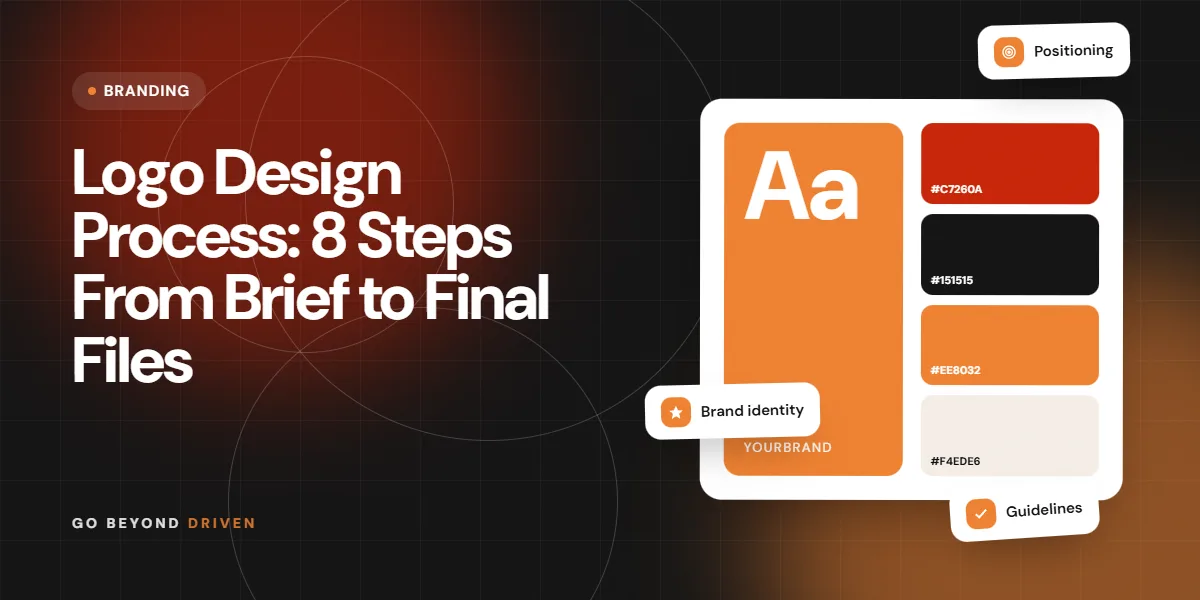
A short usage guide is also valuable, covering clear space, minimum size, colour codes and examples of correct and incorrect use. This becomes the seed of a full set of brand guidelines. Confirm in the contract who owns the copyright, when ownership transfers, and whether the designer retains the right to show the work in a portfolio.
Files to ask for:
What does a logo need beyond the artwork?
A logo is one element of a visual identity. It needs a colour palette, typefaces, imagery style and rules for combining them. Without those, every designer, printer and social media poster will interpret your brand differently. Our guide to the brand identity design process shows how a logo grows into a complete system.
Plan for application early. Check how the logo appears on signage, packaging, invoices, WhatsApp Business profiles and social media avatars. If you want help creating a mark as part of a complete identity, explore our logo design service in Mumbai or the wider branding agency offering.
Which logo design mistakes should you avoid?
Common mistakes include copying a competitor's style, using trendy effects that date quickly, relying on stock icons or templates that others can also use, adding too much detail, choosing colours without testing contrast and skipping the black and white check. Another is treating the logo as a decoration rather than an identifier that must be recognised at a glance.
Cheap marketplaces and template tools can be adequate for temporary needs, but unclear ownership, repeated artwork and missing vector files cause trouble later. Decide what the logo must do for the next five or ten years and invest accordingly. A well-designed mark rarely needs replacing, whereas a rushed one often leads to an expensive rebrand.
Final thoughts
A sound logo design process protects you from guesswork: brief clearly, let research shape the concepts, give goal-based feedback and insist on complete files and clear ownership. If you are planning a new logo or refreshing an old one, request a free marketing audit from Go Beyond Driven and we will tell you honestly whether you need a new identity or just better use of the one you have.