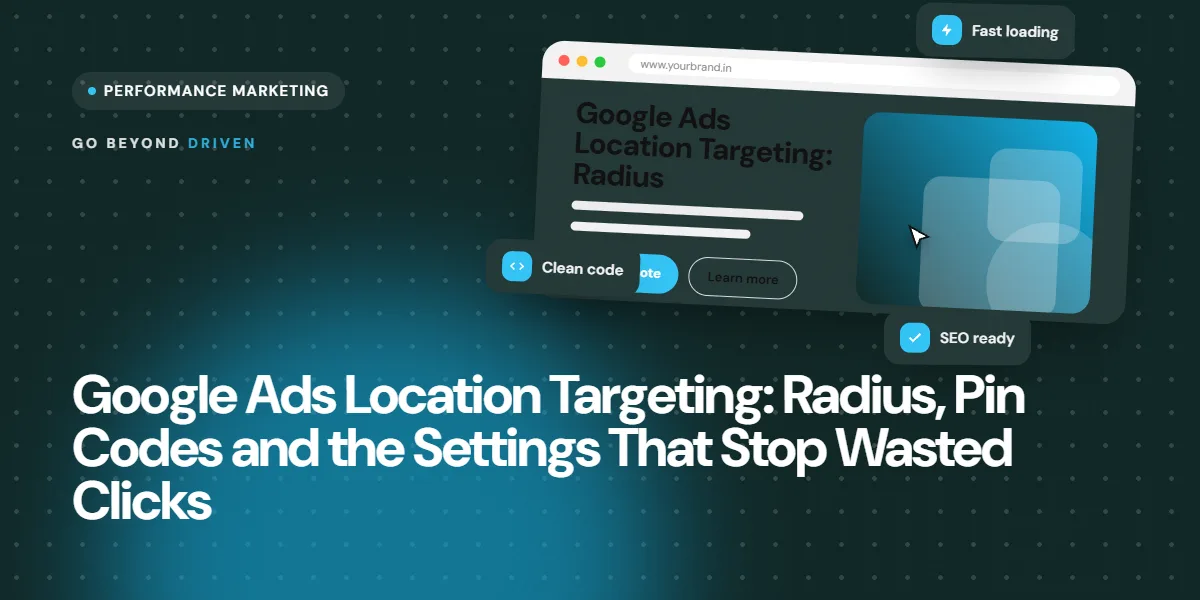
Google Ads location targeting is the set of options that decides where in the world, country or city your ads can appear, based on where people are or, depending on your settings, which places they show interest in. For a local business in Mumbai it is often the single setting that separates a profitable account from a leaking one, because the default option can show ads to people who will never visit or cannot be served. This guide explains the presence setting, when to use a radius, pin codes or named areas, how Mumbai's commute patterns affect targeting, how to handle several cities, and how to check where your clicks really came from, with a worked example for a home services business in Thane.
What is Google Ads location targeting?
Google Ads location targeting lets you choose the places where your ads can show, such as a country, state, city, area, postal code or a radius around an address, and the places where they must not show. Google works out a person's location from signals such as device location, IP address and their searches, so it is an estimate, not a guarantee, and some clicks will always come from just outside your boundary.
Location is set at campaign level, which is why businesses serving very different areas often need separate campaigns. Alongside targeting, you can exclude locations, and with manual bidding you can raise or lower bids by location. Getting these three tools right matters more for local businesses than almost any keyword decision.
What is the difference between presence and presence or interest?
Presence shows your ads to people who are in, or regularly in, your targeted locations, while presence or interest also includes people who are searching for or showing interest in those places from elsewhere. Presence or interest is the default and is labelled recommended, but for most local service businesses presence is the safer choice, because a person in Delhi searching 'Mumbai hotels' is useful to a hotel, while a person in Pune reading about Andheri is rarely useful to an Andheri salon.
Use presence or interest deliberately when people plan from afar: hotels and resorts in Lonavala or Alibag, wedding venues, property projects marketed to NRIs, hospitals receiving patients from other cities, and education courses that attract students who will relocate. For exclusions, keep the setting that excludes people in the excluded location.
FAQs: What is the difference between presence and presence or interest?
Where is the presence setting?
In the campaign settings under Locations, open 'Location options'. You will see the target and exclude options. It is easy to miss, so check it on every new campaign.
Will presence stop every outside click?
No. Location detection is an estimate, and people travelling into your area count as present. It reduces outside clicks a lot but does not remove them completely.
Should you target a radius, pin codes or named areas?
Use the option that matches how far customers will realistically travel, or how far you will travel to them. A radius around your address is simplest for a clinic, salon or showroom. Named areas and cities work when Google recognises the locality boundaries you want. Pin codes give finer control: Google Ads supports postal code targeting in many countries, and in our experience most Mumbai pin codes can be found in the location search, but check that each one resolves to the area you expect.
Mumbai's geography makes radius targeting tricky. A 5 km circle around a Bandra clinic includes parts of the sea and may reach across to areas that are a long drive away in traffic. A circle around Vashi can cross the creek into areas with a very different travel time. Draw the radius, look at the map, then add or remove areas based on actual travel time, not distance.
Choose the targeting type by business model:
How does Mumbai's commuter pattern affect location targeting?
Many Mumbai buyers search from where they work, not where they live, so your best customers may be in BKC, Lower Parel or Andheri East at 3 pm and in Thane, Mira Road or Kharghar at 10 pm. The presence setting counts people who are regularly in your target area, which includes regular commuters, but timing still shapes who sees your ad. A home service in Thane may get daytime searches from people sitting in office districts.
Think about which location matters for the sale. For a home service, the customer's home matters, so a person searching from BKC who lives in Thane is a good lead; ask for the area or pin code in your form and mention served areas in the ad. For a walk-in salon near an office district, weekday lunch hours from nearby offices may be the best time to show ads, while weekends draw residents.
How would a Thane home services business set this up?
Here is a hypothetical example to show the method. Say a home deep-cleaning service is based in Thane West and can reach Thane West, Ghodbunder Road, Majiwada, Kolshet, Vartak Nagar and Thane East within an hour. It has about Rs 35,000 a month. A lazy setup would target 'Thane' with presence or interest, and some clicks would come from across the MMR, including people searching about Thane from elsewhere.
A better setup targets the relevant Thane localities and pin codes with presence only, and excludes places across the creek it cannot reach quickly. Headlines name the areas, and the lead form asks for pin code. After a month, the team checks the locations report and enquiries by area. If Ghodbunder Road brings the most bookings at the best cost, and the business has no reason to treat areas differently, it would keep one campaign and simply refine the ads and areas. If one zone needs a very different budget or message, that zone gets its own campaign. Our page on performance marketing in Thane shows how we approach local campaigns there.
Should you use location bid adjustments or separate campaigns?
Use separate campaigns when areas need different budgets, ads or landing pages, and use bid adjustments only on manual bidding. Smart Bidding, such as Maximise Conversions or Target CPA, ignores manual location bid adjustments because it already factors location into each bid. So if you rely on Smart Bidding and want to spend more in one area, the real lever is a separate campaign with its own budget.
A common Mumbai split is island city and western suburbs, central suburbs, and Navi Mumbai and Thane, each with its own budget and area-specific ads. Do this only when the areas genuinely differ in competition, service capacity or value, because every split also divides your conversion data. Our guide to Google Ads bidding strategies explains how Smart Bidding treats these signals.
How do you write ads and keywords for local searches?
Name the area in your ads and include locality keywords, because people trust businesses that clearly serve their part of the city. Headlines such as 'Deep Cleaning in Thane West' or 'Dentist Near Andheri Station' tend to earn clicks from the right people. Location assets, which pull your address from Google Business Profile, add distance and directions, and can help your ad appear in Google Maps results too.
Keywords with place names, such as 'physiotherapist powai', match searches that name the place, while 'near me' searches rely on the person's location. With presence targeting, a person in Andheri searching 'dentist in thane' will not see your Thane ad unless they are regularly in Thane. That is usually what a local business wants. Our Google Maps ads guide covers the Maps side.
How do you check where your clicks really came from?
Open the locations report and switch between the targeted view and the view of where people actually were, which shows clicks, cost and conversions by real location. If a meaningful share of cost comes from outside your service area, check the presence setting first, then the boundaries. If one targeted area spends a lot with few enquiries, it may be too far away, too competitive or simply a poor fit for your service.
Compare this with your own records. Ask customers where they are based, capture pin code in forms and log it in your CRM. Over a few months you will see which localities bring paying customers, not just clicks, and you can tighten or expand targeting with confidence.
Monthly location check:
When should you get help with location targeting?
Get help when you serve several cities or zones with different budgets, when your locations report shows a lot of spend outside your area, or when you are launching in a new city and want to set boundaries correctly from day one. These settings are quick to change but costly to get wrong for months.
Go Beyond Driven sets up local and multi-city campaigns as a Google Ads agency in Mumbai: mapping your real service areas, choosing radius or pin code targeting, setting exclusions, writing area-specific ads and reviewing enquiries by locality every month.
Final thoughts
Location targeting is one of the cheapest fixes in Google Ads. Choose presence unless people genuinely plan from afar, target by travel time rather than distance, exclude areas you cannot serve, name the area in your ads and check the locations report every month. If you want someone to review where your ads are really showing, book a free marketing audit with Go Beyond Driven, or call or WhatsApp +91 91378 79539.