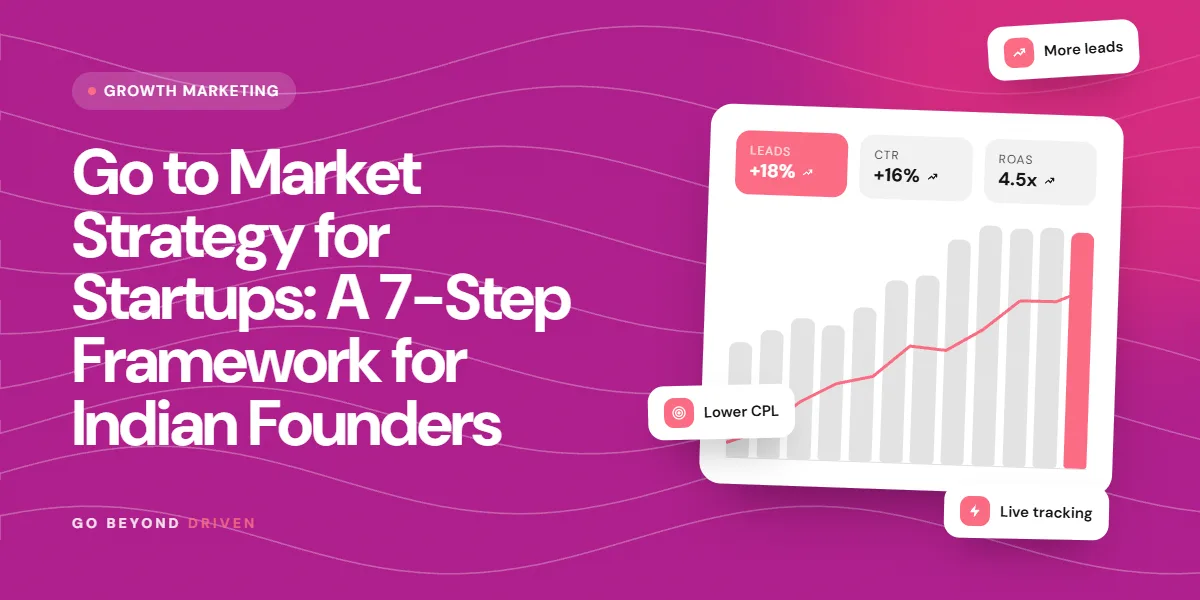
A go to market strategy for startups is the plan for how a new product reaches its first paying customers and then a repeatable flow of them: which segment you sell to first, what you promise, how you price it, how customers buy (self-serve, sales-led, through partners or marketplaces), which channels you test and which numbers show it is working. It sits between product and marketing, and many Indian startups skip it, jumping straight from a product launch to running ads. The result is usually a high cost per customer and no clear reason why. This guide breaks GTM into seven steps, with Indian examples across SaaS, D2C and services, a worked example and guidance on when outside help is worth it.
Step 1: Which customer segment should you launch to first?
Launch to the narrowest segment that has the problem most urgently, can pay for a solution and can be reached cheaply. This is often called a beachhead. For a clinic software startup it might be single-doctor dental clinics in Mumbai and Pune, not 'healthcare in India'. For a D2C snack brand it might be office-goers ordering through quick commerce in two cities, not 'health-conscious Indians'.
Test the choice by talking to twenty or thirty potential buyers before you spend on marketing. Ask how they solve the problem today, what it costs them, who decides and what would make them switch. If you cannot find and book these conversations easily, the segment may be too hard to reach for a first launch. Write the segment down in one sentence and share it with the whole team.
Step 2: What problem and promise will you lead with?
Lead with the one problem your first segment feels most and a promise you can prove, in the words customers used in your interviews. 'Cut no-shows with automatic WhatsApp reminders' is clearer to a clinic owner than 'AI-powered practice management'. The promise should explain what changes for the customer, not list features.
Check it against the real alternatives, which are often spreadsheets, a receptionist, a local vendor or doing nothing, not just other startups. Our guide to brand positioning for startups covers how to write a positioning statement and test it. Use the same promise on your website, pitch deck, ads and sales calls so every touchpoint repeats one message.
Step 3: How should you price and package at launch?
Price at launch so that the first segment can say yes quickly and you can still learn what the product is worth. Indian buyers, both businesses and consumers, are often price-sensitive and wary of long commitments from unknown brands, so monthly plans, small starter packs or paid pilots usually lower the barrier better than annual contracts or large minimum orders.
Keep packaging simple: two or three tiers at most, with a clear difference between them. Show prices including or excluding GST consistently and say which. Avoid permanent launch discounts. Instead, offer founding-customer terms with a clear end date. Record how often price comes up as an objection, because that tells you whether the problem is price or the promise.
Step 4: Which go to market motion fits your startup?
The right motion depends on deal size and how complex the buying decision is. Low-priced, simple products that users can try alone suit a product-led motion, with free trials or freemium and self-serve sign-up. Higher-value or complex B2B products usually need a sales-led motion, with demos, pilots and follow-up. Consumer products often sell through marketplaces, quick commerce or social commerce alongside a D2C website.
Partner-led motions, such as selling through distributors, consultants, CAs or industry associations, can be powerful in India where trust travels through relationships. Community-led motions suit products with an engaged user group. Pick one primary motion for the first six months. Running product-led and enterprise sales at the same time usually stretches a small team too thin.
Common GTM motions to choose from:
Step 5: Which channels should a startup test first?
Test the channels that match your motion and where your first segment already looks. A sales-led B2B startup typically starts with founder outreach on LinkedIn and email, referrals and Google Search on problem-specific keywords. A product-led app may start with content, communities and app store optimisation. A D2C brand often starts with Meta ads, creators and marketplace listings.
Run two channels at most at first, each with enough budget and time to produce real data, usually six to eight weeks. Our guide to performance marketing for startups covers paid channel setup, and growth hacking strategies for startups covers cheaper experiments.
FAQs: Step 5: Which channels should a startup test first?
Should a startup start with paid ads?
Only once the promise and landing page are tested in conversations. Ads amplify a working message. They rarely fix an unclear one.
Is SEO worth it for a new startup?
Yes as a long-term channel, especially for problem-based searches, but it usually takes months. Run it alongside a faster channel rather than relying on it alone.
Step 6: What metrics tell you the go to market strategy is working?
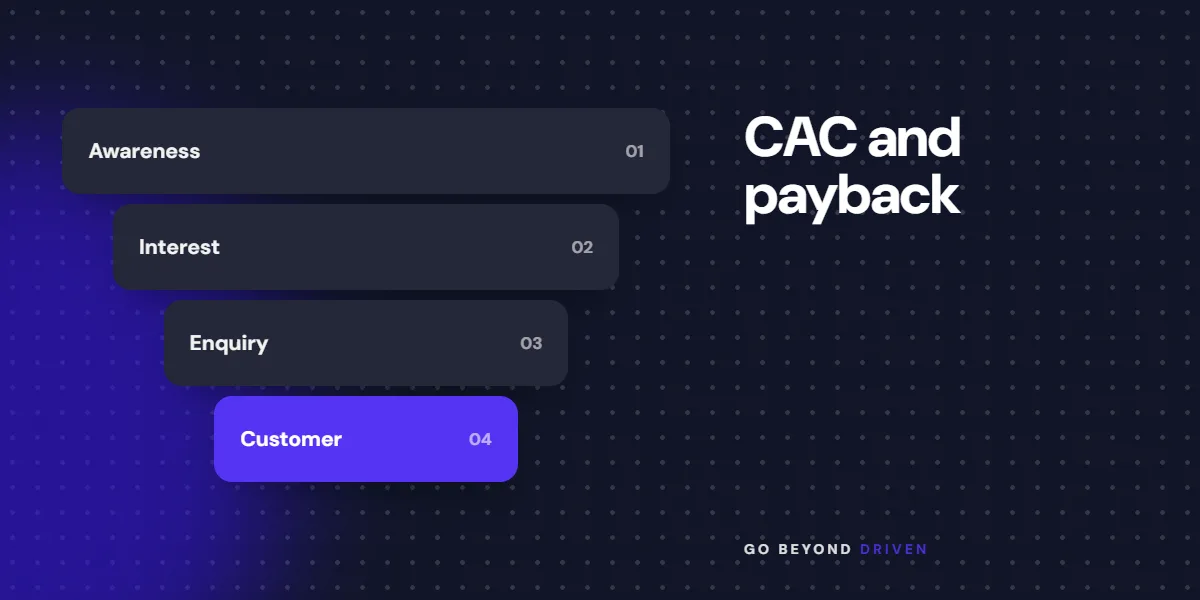
The metrics that matter are customer acquisition cost (CAC), the time it takes to earn CAC back from a customer's gross margin, activation or first-value rate, retention and the conversion rate at each step of your funnel. Leads and sign-ups are early signals, but a GTM strategy works only when customers stay and pay more than they cost to win.
Calculate CAC by channel, including ad spend, tools and a fair share of sales time, not just media cost. Our guide to customer acquisition cost explains the maths. Review these numbers monthly with the founders, and be honest when a channel has had a fair test and still does not pay back.
Core GTM metrics to review monthly:
Step 7: How do you run the launch and the first 90 days?
Run the launch as a series of small, measured pushes rather than one big event. Before launch, line up early users from your interviews, a waitlist and a few partners. In launch week, tell your network, post in relevant communities, contact the press or newsletters that cover your sector and switch on your first channel. Then spend the following weeks talking to every new customer.
Set a 90-day goal tied to the metrics above, such as a target number of paying customers in the first segment at a CAC you can afford. Hold a weekly GTM review covering what was tried, what happened and what changes next. By the end of the quarter you should know whether to deepen the segment, adjust the promise or price, or change the motion.
A worked example: GTM for a new clinic software startup in Mumbai
Say a startup builds appointment and reminder software for clinics and has about Rs 1.5 lakh a month for marketing. This is a hypothetical example to show the method. Segment: single-doctor and two-doctor dental and physiotherapy clinics in Mumbai and Pune. Promise: fewer no-shows through automatic WhatsApp reminders. Price: a monthly plan with a 30-day paid pilot. Motion: sales-led with short demos.
Channels: founder outreach to clinics through LinkedIn and dental association contacts, and roughly Rs 80,000 a month on Google Search for phrases like 'clinic appointment software' and 'patient reminder app', with the rest on content and demo videos. Target for 90 days: a clear number of paying clinics at a CAC the founders can earn back within a few months of subscription revenue.
If Google brings demo bookings but few conversions, the team checks the demo script and pilot terms before cutting spend. If association referrals convert better, they add a partner offer for consultants who set up clinics. Every number here is illustrative. The method is to fix one segment, one promise and one motion, then let measured results decide the next step.
When should a startup bring in a marketing partner?
A startup should bring in a marketing partner once the first segment and promise have been tested in real conversations and the bottleneck becomes running channels well: building landing pages, setting up tracking, running paid campaigns and producing creative fast enough. Bringing one in earlier often means paying for reach before the message is ready.
Go Beyond Driven works with early-stage teams through our startup marketing agency in Mumbai service: we pressure-test the GTM plan, build the landing pages and tracking, run focused Google and Meta tests and report CAC by channel so founders can decide where to put the next rupee.
Final thoughts
A go to market strategy for startups is a set of choices, not a launch event: one segment, one promise, simple pricing, one primary motion, two channels and a short list of honest metrics. Make the choices in writing, test them for a quarter and change them based on what customers do. If you would like a second opinion on your GTM plan, Go Beyond Driven offers a free marketing audit, or call or WhatsApp +91 91378 79539.