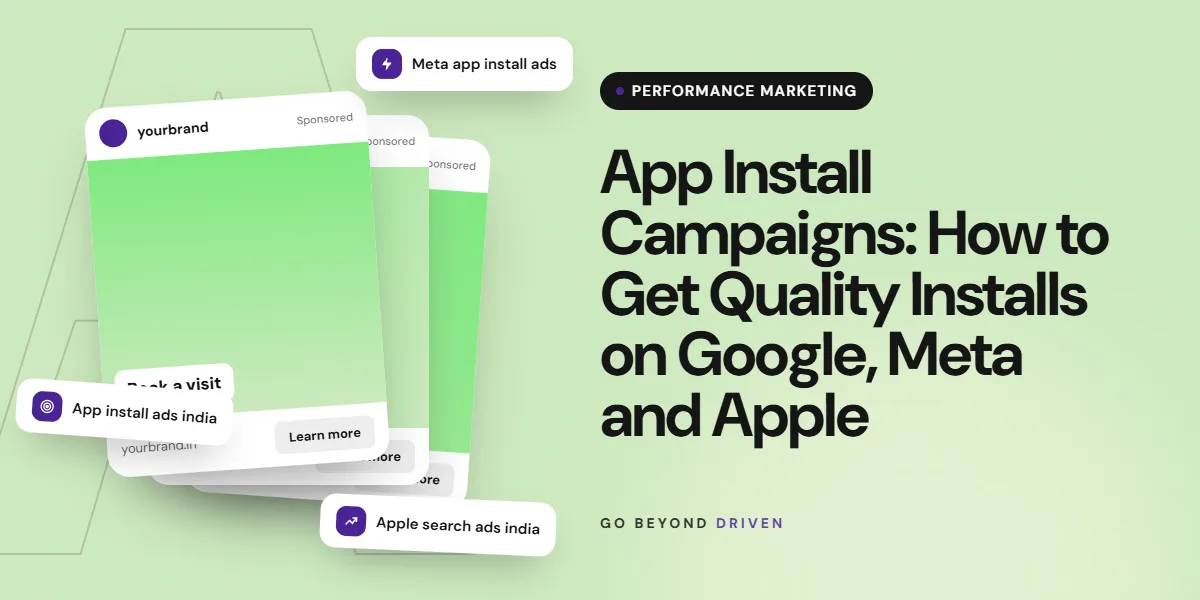
App install campaigns are paid ad campaigns built to get people to download your mobile app, with the platform's algorithm finding users likely to install and, ideally, to sign up, subscribe or buy afterwards. In India the main options are Google App campaigns, which reach Search, Google Play, YouTube and partner apps, Meta's app promotion campaigns across Facebook and Instagram, and Apple Ads inside the App Store. Installs are cheap to buy here, and that is the trap: an install that never opens the app is worth nothing. This guide covers which platforms to start with, the tracking you need, how to think about cost, when to optimise for in-app actions, how to spot fake installs and a worked example for an Indian app.
How do app install campaigns work?
App install campaigns work by handing the platform your app listing, a set of creative assets and a goal, then letting its system decide where and to whom to show the ads. On Google you supply text, images and videos, and the system builds ads for Search, Play, YouTube and the Display network. On Meta you choose an app promotion objective and the system finds people likely to install or take an in-app action across Facebook, Instagram and the Audience Network.
The key choice is what you ask the algorithm to find. You can optimise for installs, for an in-app event such as registration or first purchase, or for value, such as revenue from purchases. Each step up the funnel costs more per result but brings users who are more likely to stay. Treat the install as a means to an end, not the goal itself.
Which platforms should an Indian app start with?
For most Indian apps, Google App campaigns are the natural first channel because Android dominates the Indian smartphone market and Google can place ads directly inside the Play Store, where people are already browsing apps. Meta comes next for apps with a strong visual or social hook, such as fashion, fitness, food, dating and creator tools, because its feeds and Reels let you show the app in action.
Apple Ads, formerly Apple Search Ads, matter when your audience skews towards iPhone users, which in India often means higher-income metro buyers. Clicks there tend to cost more, but users can be valuable for premium subscriptions, finance and travel. Smaller apps should begin with one platform, prove that installs turn into active users, then add the next. Spreading a small budget across three platforms usually means none of them learns properly.
Where app install ads can run:
What tracking do you need before spending on installs?
You need to see what happens after the install, or you will optimise for the wrong thing. At minimum, connect Firebase or your analytics SDK to Google Ads and install the Meta SDK, then define a short list of in-app events such as registration, onboarding complete, add to cart, trial start and purchase. Pass revenue values where you can, so the platforms can bid for value later.
Once you run more than one channel, a mobile measurement partner, or MMP, such as AppsFlyer, Adjust or Branch, becomes useful. It attributes each install to one source, de-duplicates claims from different networks, supports deep links and offers fraud protection. On iOS, Apple's privacy framework limits user-level tracking, so attribution relies on aggregated, delayed data through SKAdNetwork or AdAttributionKit. Our conversion tracking setup guide covers the web side of the same discipline.
How much does an app install cost in India?
Cost per install in India varies widely by category, platform and goal, and the figures here are hedged observations rather than benchmarks. Simple Android installs for utility, entertainment or casual gaming apps can sometimes cost only a few rupees each. Apps in finance, insurance, education and premium subscriptions often pay several times more, and iOS installs typically cost more than Android because the audience is smaller and more valuable.
The more useful number is cost per meaningful action. If installs cost Rs 20 but only one in four users registers, your cost per registered user is Rs 80. If one in twenty of those pays, a paying user costs Rs 1,600. Compare that with what a paying user is worth over six or twelve months. A higher cost per install with better retention often beats cheap installs that churn within a day.
FAQs: How much does an app install cost in India?
Why are iOS installs more expensive than Android?
iPhone users are a smaller share of Indian smartphone owners and tend to spend more, so more advertisers compete for them. Privacy limits on iOS also make targeting and measurement less precise, which can push prices up.
Can I run app ads with a very small budget?
You can start small, but in-app event optimisation needs a steady flow of conversions to learn. If your budget cannot produce enough events each week, optimise for a more frequent event such as registration first.
Should you optimise for installs or in-app actions?
Start with installs only when you have no conversion history, then move to in-app actions as soon as you can. Optimising for installs teaches the platform to find people who install easily, which is not the same as people who use the app. Once your tracking shows a reasonable volume of registrations or purchases each week, switch to a target cost per action, and later to a value or return-on-ad-spend target if you sell in-app.
Pick an event that happens often enough to learn from but still signals intent. For a lending app, completed KYC may be too rare at first, while 'loan offer viewed' might be frequent and meaningful. For a shopping app, first purchase is ideal once volumes allow. Avoid changing the target event and bid every few days, because each change resets the learning and makes results look worse than they are.
What creative works for app install ads?
Show the app doing its job within the first two seconds. Screen recordings with a finger tapping through the main feature, a short vertical video of a real person solving a problem with the app, and before-and-after style comparisons usually outperform polished brand films. Make one clear promise per ad, such as 'Order groceries in Hindi' or 'Track every SIP in one place', and test several angles at once.
Your store listing is part of the ad. Many people tap through, look at the screenshots, rating and app size, and leave. Clear screenshots with captions, a short preview video, recent positive reviews and a compact download size all lift the install rate, which lowers your cost per install. For many Indian users on mid-range phones with limited storage, a smaller app genuinely matters.
Creative and listing checks before launch:
A worked example: Rs 1.5 lakh a month for a fitness app
Say a hypothetical Mumbai-built fitness app with a paid plan has Rs 1.5 lakh a month. It puts Rs 1 lakh into Google App campaigns on Android and Rs 50,000 into Meta, both optimising at first for registration. If installs average Rs 25, the budget buys about 6,000 installs. If 35 percent register, that is 2,100 registered users, or roughly Rs 71 each.
If 4 percent of registered users start a paid plan, the app gets about 84 subscribers, close to Rs 1,800 each. If a subscriber pays Rs 300 a month and stays for, say, eight months on average, they bring Rs 2,400, which leaves a thin margin. The team would then work on onboarding, the paywall and retention, and move bidding to trial starts once volumes allow. These numbers illustrate the method only.
How do you spot fake installs and wasted spend?
Watch for installs that look busy but never behave like real people. Warning signs include very short time between click and install, a spike of installs from one network or one city with almost no opens, unusual device types, and day-one retention far below your normal level. Click injection and install farms exist, especially on some partner networks, and they can claim credit for installs that would have happened anyway.
Use your MMP's fraud protection, judge every source on in-app events rather than installs, and pause sources where users do not register or return. Also check for overlap: if your brand is searched on Play Store, some paid installs are people who would have found you anyway. A small holdout test, pausing one channel for a defined period in one region, can show how much each source really adds.
When should you hire help with app install campaigns?
Hire help when spend is growing, more than one platform is involved, or your installs are not turning into active users. App marketing mixes ad buying, SDK and MMP setup, store listing work and creative production, and gaps in any one of them waste budget quickly. An agency should start by checking tracking and in-app events, then set clear targets for cost per registered and paying user.
Go Beyond Driven sets up and runs app campaigns on Google and Meta for Indian apps, working with your developers on events and attribution, producing short app-demo creative and reporting weekly on cost per active and paying user. Our performance marketing company in India page explains our approach, and our post on influencer marketing for apps covers creator-led installs.
Final thoughts
App install campaigns work when you treat the install as the first step, not the finish line. Get tracking right, start on the platform where your users already are, optimise for in-app actions as early as you can, and judge every channel on active and paying users. If you would like a review of your app funnel and campaigns, book a free marketing audit with Go Beyond Driven, or call or WhatsApp +91 91378 79539.