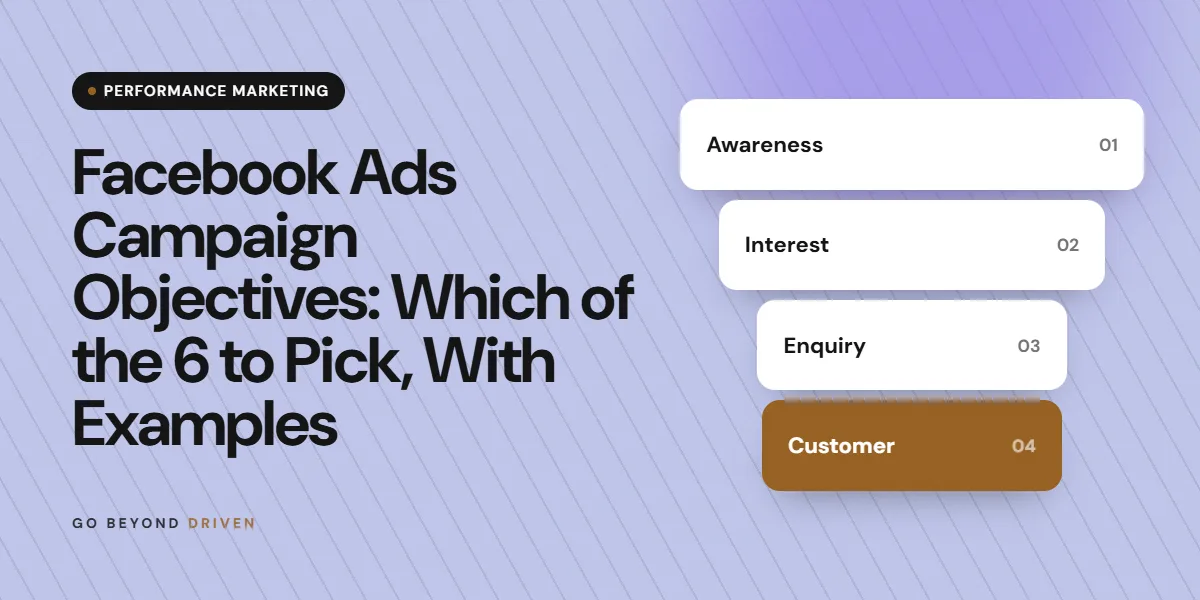
Facebook ads campaign objectives are the six goals Meta asks you to choose when you create a campaign: Awareness, Traffic, Engagement, Leads, App promotion and Sales. The objective tells Meta's delivery system which action to look for, so it decides who sees your ads, what you pay for and what the results column shows. Pick the wrong one and you can get thousands of cheap clicks and no enquiries. This guide explains what each objective really optimises for, how the objective connects to the conversion location and performance goal inside the ad set, which choice suits lead generation, online stores and launches, and the most common mistakes we see when reviewing Indian ad accounts. A worked example at the end shows the thinking on a real-world sized budget.
What are the six Facebook ads campaign objectives?
The six Facebook ads campaign objectives are Awareness, Traffic, Engagement, Leads, App promotion and Sales, grouped roughly from the top of the funnel to the bottom. Meta simplified a longer list into these six a few years ago, and they apply to ads on Facebook, Instagram, Messenger, WhatsApp and the Audience Network.
Awareness shows your ad to as many relevant people as possible, or to the people most likely to remember it. Traffic sends people to a destination such as a website or app. Engagement looks for interactions: messages, video views, post engagement, event responses or calls. Leads collects enquiries through instant forms, chats, calls or your website. App promotion drives installs and in-app actions. Sales finds people likely to buy, on your website, in your app or through a chat.
The six objectives, from top of funnel to bottom:
Why does the campaign objective matter so much?
The objective matters because Meta delivers your ad to the people it predicts are most likely to take the action you asked for. Choose Traffic and the system finds people who click links often. Choose Leads and it looks for people who fill forms. These are not always the same people, and the gap shows up in your cost per qualified enquiry, not in the click-through rate.
In our experience, many small accounts in Mumbai that complain about 'useless leads' or 'clicks but no sales' are simply optimising for the wrong action. The objective is also hard to change later: once a campaign is live, Ads Manager generally does not let you switch its objective, so you duplicate into a new campaign and the learning starts again. Getting this choice right on day one saves money and weeks.
How do objective, conversion location and performance goal fit together?
They are three layers of one decision. The campaign objective is the broad goal. Inside each ad set you then pick a conversion location, meaning where the action happens: your website, an instant form, Messenger, Instagram Direct, WhatsApp, a phone call or an app. Finally you choose a performance goal, such as maximise the number of leads, conversions, landing page views, conversations or the value of conversions.
The performance goal is the event Meta actually optimises for, so it deserves the same care as the objective. A Leads campaign with the website as the location can optimise for a Lead event fired on your thank-you page, which only works if that event is tracked correctly. The options shown change with the objective and are updated by Meta from time to time, so treat any list you read, including this one, as accurate at the time of writing.
Which objective should a lead generation business choose?
A lead generation business should usually choose the Leads objective, then pick the conversion location that matches how your customers like to talk. Instant forms are the easiest to start with because people never leave Facebook or Instagram, though the convenience can bring casual sign-ups. Our Facebook lead ads guide covers form design that filters them.
For many Indian service businesses, WhatsApp is the better location because buyers already prefer chatting there and you can qualify them in the conversation. The click-to-WhatsApp ads guide explains the setup. A website location suits businesses with a strong landing page and reliable tracking. If you can send lead outcomes back from your CRM, the conversion leads performance goal lets Meta optimise towards leads that became customers rather than raw form fills.
Which objective should an online store choose?
An online store should choose the Sales objective and optimise for purchases, provided your Meta Pixel and Conversions API report purchases accurately. Sales campaigns can also use a product catalogue to show people the items they viewed, and Meta's more automated Advantage+ sales setup sits under this objective too.
The catch is data volume. A new store with only a handful of purchases a week gives the system little to learn from. Some advertisers temporarily optimise for add to cart or initiate checkout to collect more signals, then switch to purchase once volume builds. This can help, but it can also find window shoppers, so judge it on cost per purchase from your store's own order data. We cover store-specific structure in our guide to Facebook ads for ecommerce.
When do Awareness, Traffic and Engagement make sense?
Awareness, Traffic and Engagement make sense when the business goal is attention rather than an immediate enquiry or sale. A new restaurant opening in Powai, a Ganeshotsav or Navratri event, or a brand entering a new city may want reach and recall first. Video views under Engagement are also a cheap way to build a warm audience you can retarget later with a Leads or Sales campaign.
Traffic is the objective most often misused. It works when you genuinely want visits, for example to a blog post you will retarget, or when you cannot track conversions at all. If you want enquiries and your site is tracked, a Leads or Sales campaign optimising for the real event is usually the stronger choice. Engagement campaigns optimising for messages can work well for very local, chat-led businesses.
FAQs: When do Awareness, Traffic and Engagement make sense?
Is boosting an Instagram post the same as an Engagement campaign?
Not quite. Boosting is a simplified flow with fewer settings. It can optimise for profile visits, messages or engagement, but Ads Manager gives you full control over objective, audience, placements and tracking.
Can Awareness campaigns bring leads?
Sometimes indirectly, because people remember you and search or message later. They are not built to find enquirers, so measure them on reach, frequency and later branded searches, not on cost per lead.
Worked example: choosing objectives for a Rs 25,000 monthly budget
Say a new home tuition service in Thane has Rs 25,000 a month for Meta ads and wants parent enquiries for classes 8 to 10. This is a hypothetical example to show the method, not a real client. The goal is enquiries, parents prefer WhatsApp, and the team can reply within minutes during the day, so the main campaign uses the Leads objective with WhatsApp as the conversion location.
Roughly Rs 20,000 goes to that one Leads campaign, with a single ad set targeting Thane and nearby areas and three or four creatives. The remaining Rs 5,000 runs a small Engagement campaign for short video views of a teacher explaining the method, which builds a warm audience to retarget. If enquiries arrive at, say, Rs 250 to Rs 400 each, the main campaign might produce somewhere between 50 and 80 chats a month. The team then tracks how many become demo classes, because that number, not chat volume, decides whether the objective choice is working.
What mistakes do people make with campaign objectives?
The most common mistake is choosing the cheapest-looking result instead of the action that pays. Traffic and Engagement produce low costs per result because those actions are easy, which looks good in a report and does little for revenue. The second is optimising for an event that is not tracked properly, such as a Lead event that fires on every page load, which teaches Meta to find the wrong people.
Other mistakes include splitting a small budget across five campaigns with different objectives, changing objectives every week before any campaign has learned, and boosting posts when the goal is enquiries. Each new campaign or ad set needs enough conversions to settle, which our guide to the Facebook ads learning phase explains.
Objective mistakes that quietly waste budget:
When does it make sense to get help with Meta campaign setup?
It makes sense to get help when you are spending real money every month but cannot say which objective, event and conversion location are producing paying customers. That usually means tracking, structure and follow-up need fixing together, and doing it alone takes time most owners do not have.
A good agency should start by asking what a customer is worth to you and how leads are handled, then set up tracking, choose the objective and performance goal that match, and report on cost per qualified lead or purchase. As a Meta ads agency in Mumbai, Go Beyond Driven audits existing campaigns, rebuilds structure around the right objectives, connects CRM or WhatsApp outcomes where possible, and runs a steady creative testing routine so the system keeps learning.
Final thoughts
Choose the objective that matches the action that makes you money, then make sure the conversion location and performance goal point at that same action and are tracked correctly. Everything else in a Meta account, from audiences to creative, works better once this foundation is right. If you would like a second opinion on your current setup, Go Beyond Driven offers a free marketing audit, and you can also call or WhatsApp us on +91 91378 79539.